
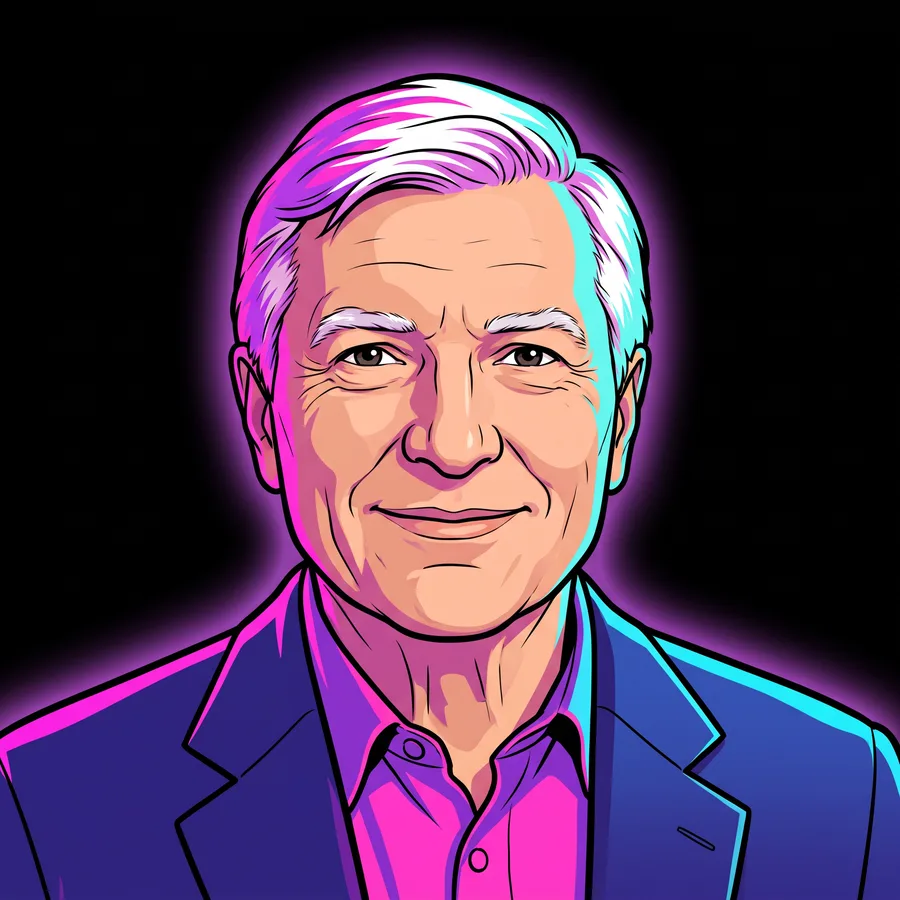
Some people make history without anyone really noticing at the time. Terry Sejnowski is one of them. This physicist-turned-neuroscientist spent decades asking whether a machine could genuinely learn to think, the way a human brain does. It was the 1980s, neural networks were technically alive but practically abandoned, and most of the artificial intelligence field had moved on to other bets. Sejnowski didn't change his.
In 1985, alongside Geoffrey Hinton, he invented the Boltzmann Machine: the first multi-layer neural network architecture capable of learning representations of the world from data. That same year, Sejnowski unveiled NETtalk, a program that learned to read text aloud through training alone, with no programmed rules. In a public demonstration, the network babbled nonsense sounds, then words, then phrases. The room went quiet. It was 1986 and a machine had just learned to speak.
From the Salk Institute for Biological Studies in La Jolla, California, Sejnowski has spent more than four decades building the bridge between neuroscience and artificial intelligence. He holds the Francis Crick Chair at the Salk, is a professor at UC San Diego, and directs the Computational Neurobiology Laboratory. He founded the journal Neural Computation in 1989, published by MIT Press, and served as president of the NeurIPS Foundation, which organizes the world's most influential AI conference. His awards include the Gruber Prize in Neuroscience (2022) and the Brain Prize (2024, considered the "Nobel of neuroscience"), plus memberships in the U.S. National Academy of Sciences and National Academy of Engineering.
To me, Sejnowski's lesson is about the patience of believing. He worked on ideas nobody wanted to fund for years, and today those ideas are the engine behind language models like Claude, image recognition systems, and nearly everything we call AI. When you use an AI assistant to organize your work or learn something new, there's a quiet debt owed to a curious physicist who insisted on listening to what the brain had to teach the computer.
Official links for Terry Sejnowski, The bridge between brain and machine
More figures who shaped AI in AI Legends, or back to the news.