
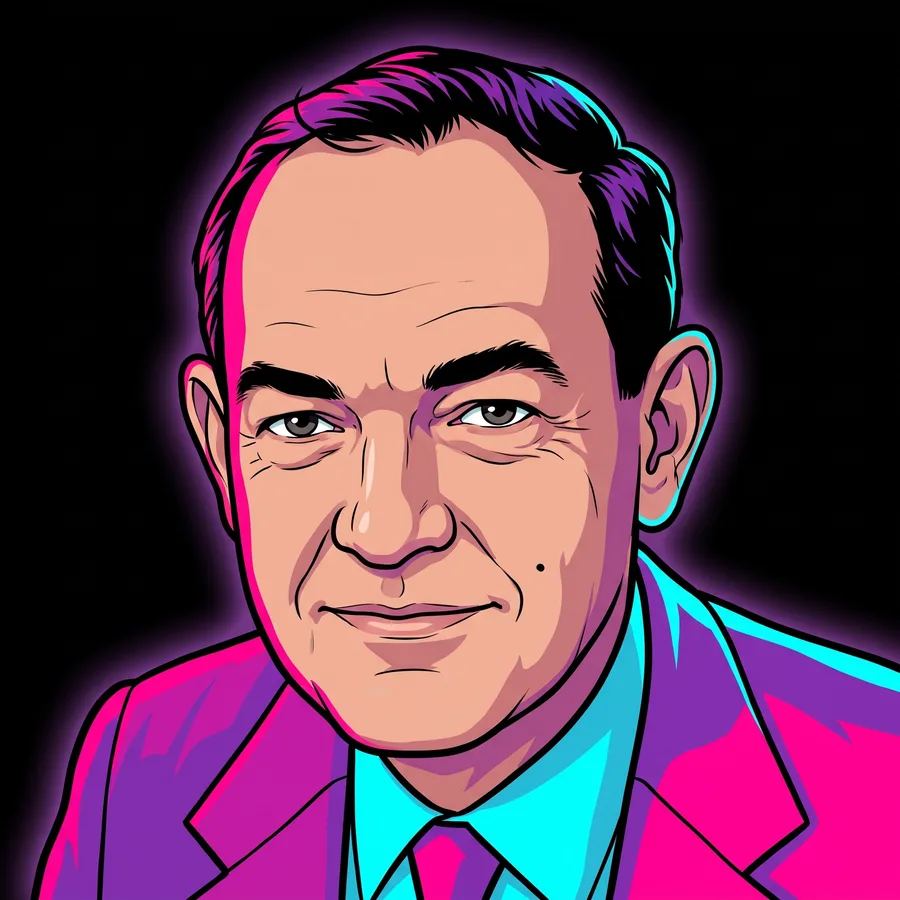
Some people change one field. Herbert Simon changed four at once: economics, psychology, computer science, and philosophy of mind. This man from Milwaukee, Wisconsin, born in 1916, spent his career at Carnegie Mellon University convinced of an idea that sounded radical in the 1950s: that human thought can be modeled, and that a machine can do something similar. At a time when science treated the brain and the computer as separate worlds, Simon refused to accept that boundary.
In 1956, together with Allen Newell and with the help of John Cliff Shaw, he created the Logic Theorist: the first computer program that could prove mathematical theorems on its own. It wasn't a calculator; it was something different, something that reasoned. That same year, at a conference at Dartmouth College, the term "artificial intelligence" was coined. Simon and Newell arrived with the Logic Theorist already running. Years later they built the General Problem Solver, a program designed to mimic the way humans solve problems in general, not just mathematics. For all that work, in 1975 he received the Turing Award alongside Newell, the highest recognition in computer science, for "basic contributions to artificial intelligence, the psychology of human cognition, and list processing."
But it didn't stop there. In 1978, the Nobel Committee awarded him the Prize in Economic Sciences for his research into how people and organizations make decisions. Simon showed that human beings are not the perfectly rational agents classical economics assumed: we have limited cognitive resources, so we make "good enough" decisions rather than optimal ones. He called that principle "bounded rationality," and it changed economic theory forever. Simon is one of the very few human beings in history to have won both the Nobel and the Turing Award.
To me, Herbert Simon is proof that the best ideas don't respect disciplinary boundaries. He dared to ask questions no one else was asking: how do people think? can a machine imitate that? why do we decide what we decide? Today, when you ask Claude to help you work through a complex problem, there's an echo of those 1950s questions in every answer. Simon passed away in 2001, but his curiosity lives on in every AI system that tries to understand how a human being reasons.
Official links for Herbert Simon, The man who taught machines to think (and economists too)
More figures who shaped AI in AI Legends, or back to the news.