
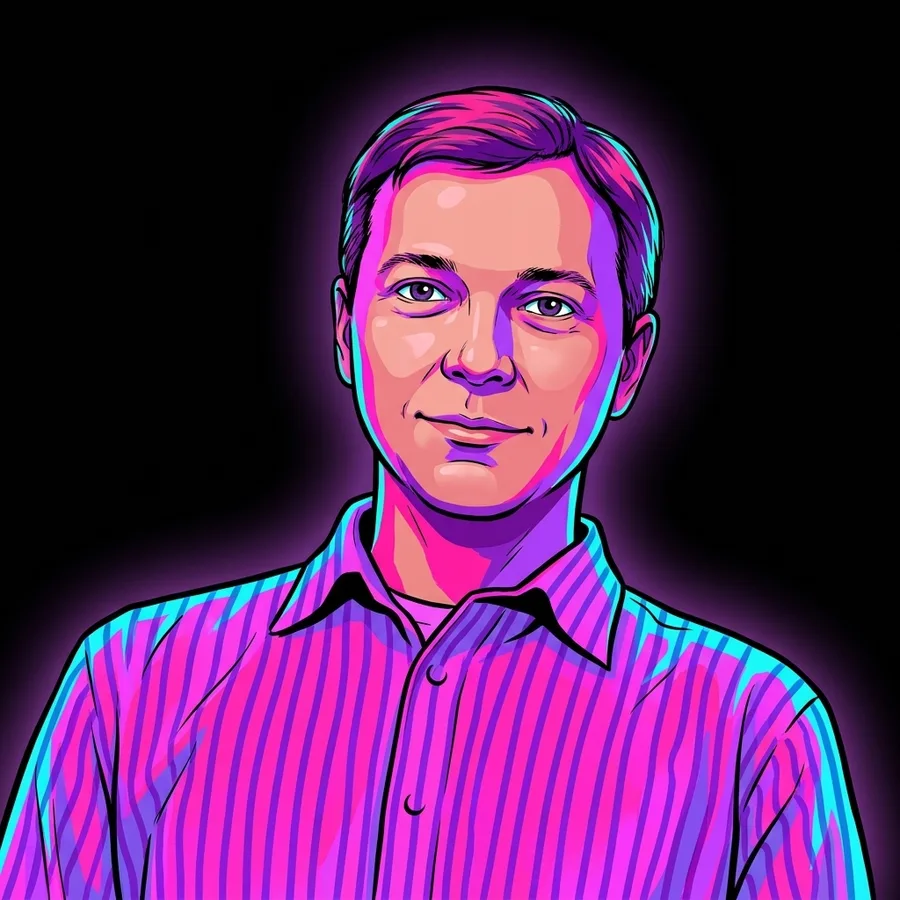
Ruslan Salakhutdinov arrived in Toronto in search of something almost no one took seriously: a mathematical path to teach machines to imagine. Born in Tashkent, Uzbekistan, he found in Geoffrey Hinton, the future Nobel laureate in Physics, a mentor and fellow stubborn believer. While most of the academic world was betting on other methods, the two kept insisting that deep neural networks could capture the hidden structure of the real world. That took courage, because at the time, that idea had just been declared dead for the second time.
In 2009, during his PhD at the University of Toronto, Salakhutdinov and Hinton published "Deep Boltzmann Machines" at the AISTATS conference. The paper laid the mathematical foundations for a network to learn representations across multiple layers starting from unlabeled data: teaching a machine to understand before teaching it to answer. That work helped establish the basis for what we now call generative models, the same ones that produce the images, text, and responses you see in today's AI tools. With over 200,000 citations on Google Scholar, its impact keeps growing.
After his PhD, his career became the perfect bridge between theory and real-world application at scale. In 2016 he joined the Machine Learning Department at Carnegie Mellon University as UPMC Professor, and at the same time took on the role of Director of AI Research at Apple, where he led teams that bring machine learning to the devices of hundreds of millions of people. In 2021 he moved to Meta as VP of AI Research at FAIR, the company's flagship AI research lab, focused on large-scale multimodal models and AI agents. He served as Program Co-Chair for ICML 2019 and General Chair for ICML 2024, the world's premier machine learning conference. His recognitions include the Alfred P. Sloan Research Fellowship, the Microsoft Research Faculty Fellowship, and the Google Faculty Award.
What I find fascinating about Russ (as the field calls him) is that he never chose between academia and the real world: he found a way to live in both at the same time. Today, when you open your phone and an AI assistant understands a photo and a text together, or when a model generates a response that seems to have "grasped" your context, there are ideas of his working underneath. The lesson is clear: mathematical foundations, no matter how abstract they seem, are the ones that end up changing the world. And if you want to understand where these tools come from, there is no better starting point than exploring them yourself, for instance with Claude.
Official links for Ruslan Salakhutdinov, The scientist who imagined generative AI
More figures who shaped AI in AI Legends, or back to the news.