
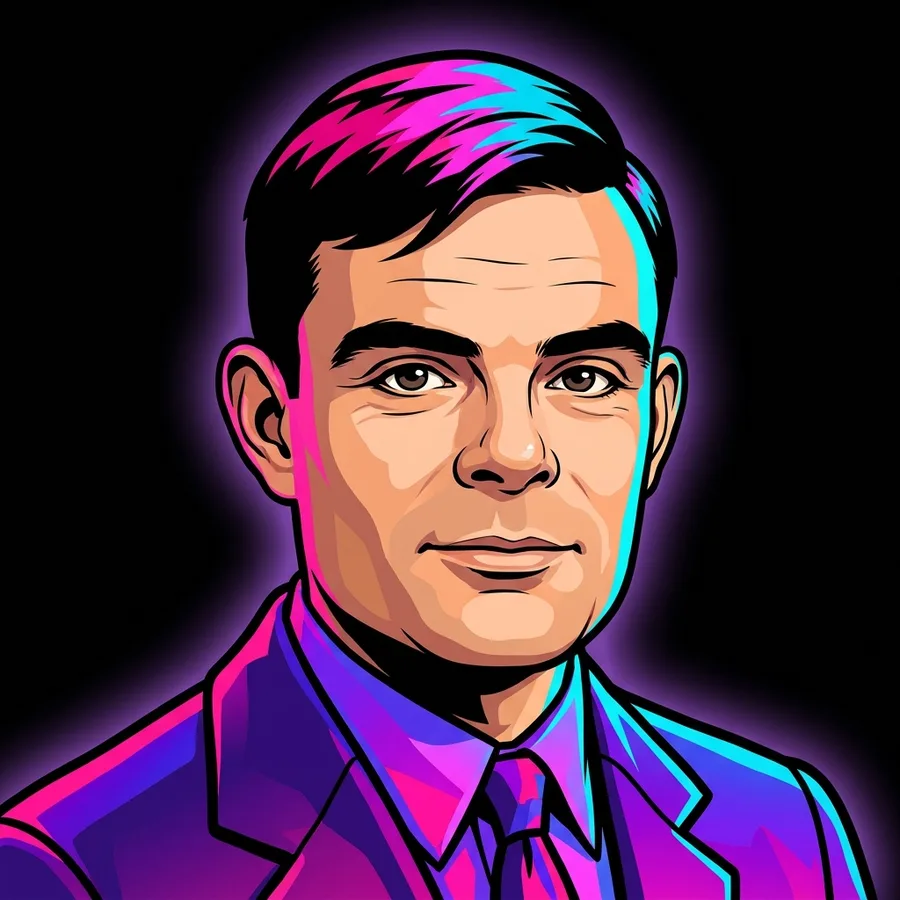
Some people arrive in the world so far ahead of their time that it takes decades for the world to catch up. Alan Turing was one of them. A British mathematician born on June 23, 1912, Turing asked a question no one had dared to formalize: can a machine think? In 1950, when computers barely filled entire rooms and were used to calculate payrolls, he published the paper "Computing Machinery and Intelligence" and proposed what we now know as the Turing Test: if a machine can hold a conversation with a human without that person realizing they are talking to a machine, then what real difference is there?
But Turing wasn't just philosophizing. During World War II he worked at Bletchley Park, the United Kingdom's secret codebreaking center, where he led the team that cracked the Enigma machine codes, the encryption system the Nazis used for their military communications. That work is estimated to have shortened the war by two to four years and saved millions of lives. To achieve it, Turing designed the "Bombe," an electromechanical machine that could find Enigma's daily settings at a speed impossible for any human. He received the Order of the British Empire (OBE) in 1945 for that service.
After the war, he contributed to the development of modern computing: he worked on early stored-program computer prototypes in Manchester and proposed ideas about mathematical morphogenesis still studied in biology today. His doctoral thesis at Princeton (1938) on "computable numbers" laid foundations we still use. However, in 1952 he was prosecuted for "gross indecency" for his homosexuality, which British law criminalized at the time. As an alternative to prison, he accepted chemical castration. He died on June 8, 1954, at age 41, under circumstances still debated (officially, cyanide ingestion). In 2013, Queen Elizabeth II granted him a posthumous royal pardon.
Turing's lesson isn't only scientific: it's about having the courage to ask the hard questions when no one else is asking them. Today, every time you write to an AI assistant or a machine understands you in your own language, something of Turing's original question is operating underneath: can a machine think? We now know part of the answer. The Turing Award, the highest honor in computer science given annually by the ACM, bears his name precisely because he imagined all of this first.
Official links for Alan Turing, The father of artificial intelligence
More figures who shaped AI in AI Legends, or back to the news.