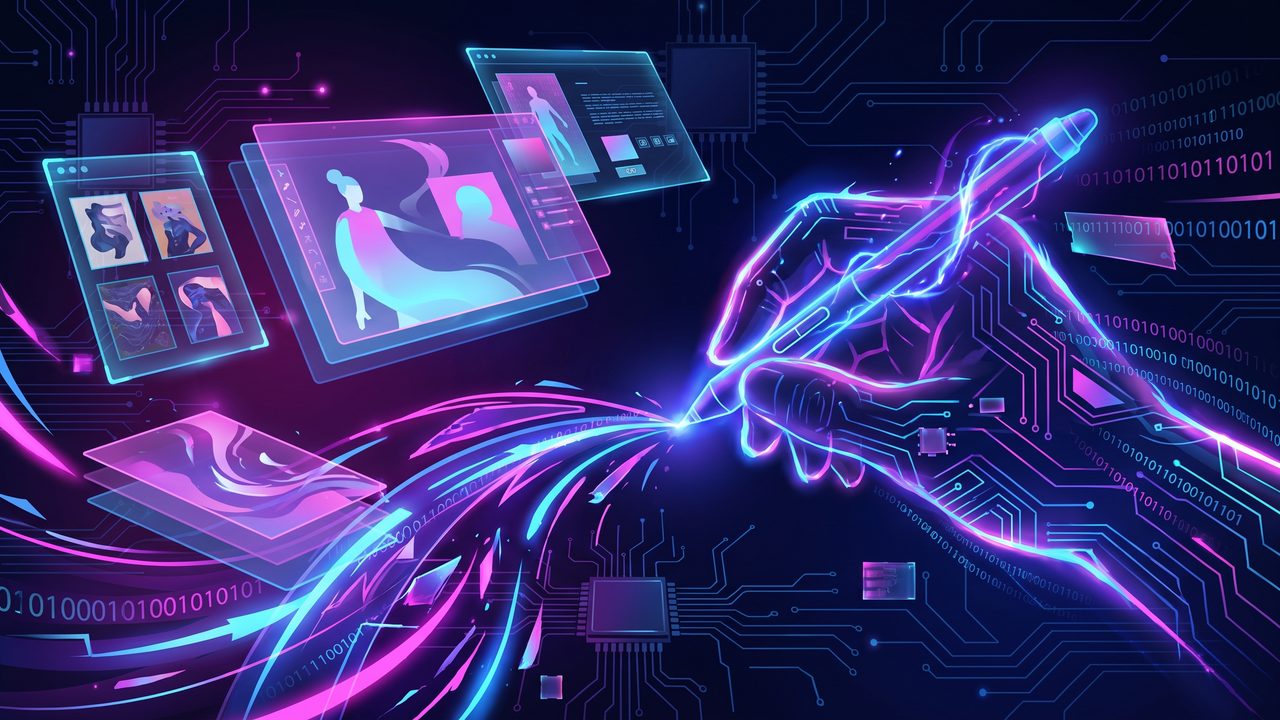
If you’re an illustrator, you’ve probably felt that knot in your stomach: the AI that “draws in seconds” what takes you hours. I get it. But let me offer you another way to look at it. AI for illustrators doesn’t have to be the thing that takes your work away: it can be the thing that takes away the tedious part and gives you more time for what you actually do well, which is having a style and telling stories with an image.
It’s not about the machine drawing for you. It’s about it helping you reach your best idea faster.
What AI can do for your process
Think of AI as a studio assistant that never gets tired. It doesn’t sign your work, but it keeps you company through the parts nobody enjoys. From a description or an image you give it, a modern AI can:
- Generate quick visual references: poses, lighting angles, color palettes, compositions to spark ideas
- Propose variations of a sketch so you can see options before committing
- Suggest composition structures (rule of thirds, focal point, depth)
- Draft the description of your work for your portfolio or shop
- Help you price a piece and write the email you send the client
What used to make you open twenty Pinterest tabs, you now solve in a chat.
References, not the final drawing
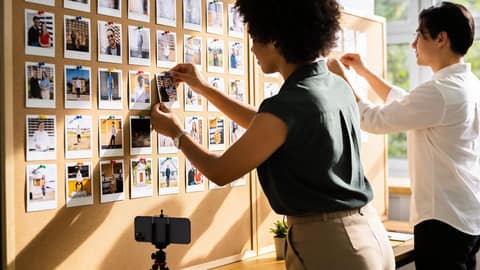
Here’s the key to using AI without losing yourself: use it for the reference stage, not for the final piece. A good illustrator always looked for references (photos, other work, life drawing). AI is just one more source of reference, only infinite and tailored to you.
Try asking: “Give me 6 references of poses of a person running in the rain, side view, dramatic lighting”. Not to trace them, but to study the movement and the light, and then draw with your hand and your style. The difference between copying and studying is the same as ever: your judgment.
Assisted sketches, your decisions
In the sketch phase, AI is great for exploring fast. You describe the scene and it returns several compositions. You pick the one that speaks to you, redo it your way and move on. It’s like having a brainstorming partner that doesn’t get offended when you say “no, not like that”.
AI gives you options at the speed of thought. Choosing well is still an artist’s job.
Protecting your artistic style
This is the part that matters most, and the one almost nobody explains well:
- Don’t upload your original work to tools that aren’t clear about what they do with your images. Read the data policy before loading anything of yours.
- Check whether the tool lets you exclude your work from training its models; several already offer this.
- Consider registering your work and using watermarks or style-protection tools when you publish.
- Your real signature is your judgment, your narrative and your decisions. That can’t be copied with a prompt.
Using AI to get inspired is one thing. Giving your work away to train others is another. You decide where that line goes.
Start small
You don’t have to change how you draw tomorrow. Start with a single task: next time you need references, ask an AI like Midjourney or ChatGPT instead of losing an hour searching. You draw, with your hand. And notice how much time you get back for what you love.
I’m not an illustrator, and I build things with AI every day. You, with your talent and your eye, can use it as one more tool in your studio, without ever stopping being the artist. You just have to start.
Want these tools compared in depth? Check the unbiased reviews.