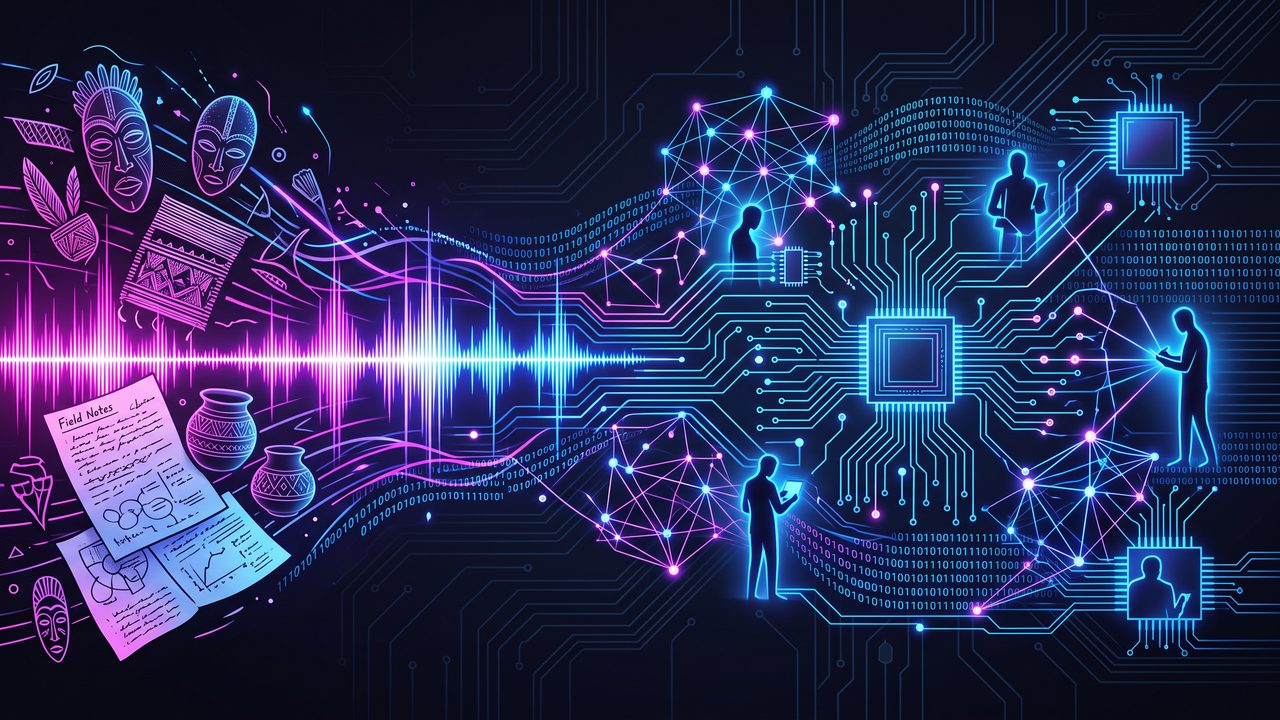
If you’re an anthropologist, you know fieldwork generates a mountain of material: hours of recorded interviews, notebooks full of notes, photos, field diaries. And then comes the heavy part: transcribing, organizing and making sense of all of it. The good news is that artificial intelligence can already assist with a big chunk of that work.
Not to replace your eye. To take away the mechanical part and leave you the cultural interpretation, which is the heart of your discipline.
What AI can do with your fieldwork
Think of AI as an assistant you hand the raw material to (your recordings, your field notes) and it returns something nearly ready to analyze. A modern AI can:
- Transcribe hours of ethnographic interviews in minutes
- Organize your scattered field notes into themes and categories
- Identify patterns and connections across a large body of material
- Help you draft your report or your ethnography
- Translate material between languages to work with diverse communities
What used to take you weeks of transcription by hand can now take an afternoon.
Transcription: the biggest time saver
Transcribing is the task every anthropologist dreads. AI tools like Whisper (from OpenAI) turn your recordings into text with good accuracy, even across several languages. The flow is simple:
- You upload the audio of your interview to the tool.
- You get the transcript in minutes, not hours.
- You review and correct it. Here your trained ear is key: proper names, local terms, cultural expressions the machine doesn’t capture well.
- You analyze it. You ask an AI like Claude or ChatGPT to identify the recurring themes or the tensions that appear in the account.
The machine does the raw transcription; you bring the context and cultural sensitivity.
Analyzing field data
With your notes and transcripts ready, AI helps you find patterns that sometimes get lost in the volume. You can ask: “Compare how older versus younger participants talk about the ritual” or “Identify the contradictions between what they say and what I observed”. The AI sweeps, you interpret. It never replaces your knowledge of the terrain or your theoretical framework.
Writing reports and ethnographies
Here AI is a writing partner. You can give it your loose ideas and ask it to organize them into a structure, suggest how to thread a section together, or check whether your description is clear. It also polishes style and translates, useful when you publish for audiences in another language.
The important part: your judgment and your ethics rule
AI is incredibly fast, but it doesn’t understand culture. It can misread a local term, erase an important nuance or invent a quote. So:
- Always verify every transcript and every data point. AI sometimes “fills in” what it doesn’t understand from the audio.
- Protect the people you work with. Field material is sensitive and often confidential. Anonymize and check privacy policies before uploading anything; consider what you agreed on with the community.
- The interpretation is yours. Use AI to transcribe and organize, not to interpret culture for you. Review the ethical rules of your discipline and your institution.
AI does the mechanical 80%. The 20% that requires your cultural sensitivity and your responsibility toward communities stays yours, and that’s your contribution.
Start small
You don’t have to transform your method tomorrow. Start with a single task: that interview you haven’t transcribed for weeks. Run it through an AI this week and see how much time it gives back for what really matters: thinking.
If I, without being an anthropologist, can build things with AI, you with your training and your critical eye can achieve so much more. You just have to start.
Want these tools compared in depth? Check the unbiased reviews.