
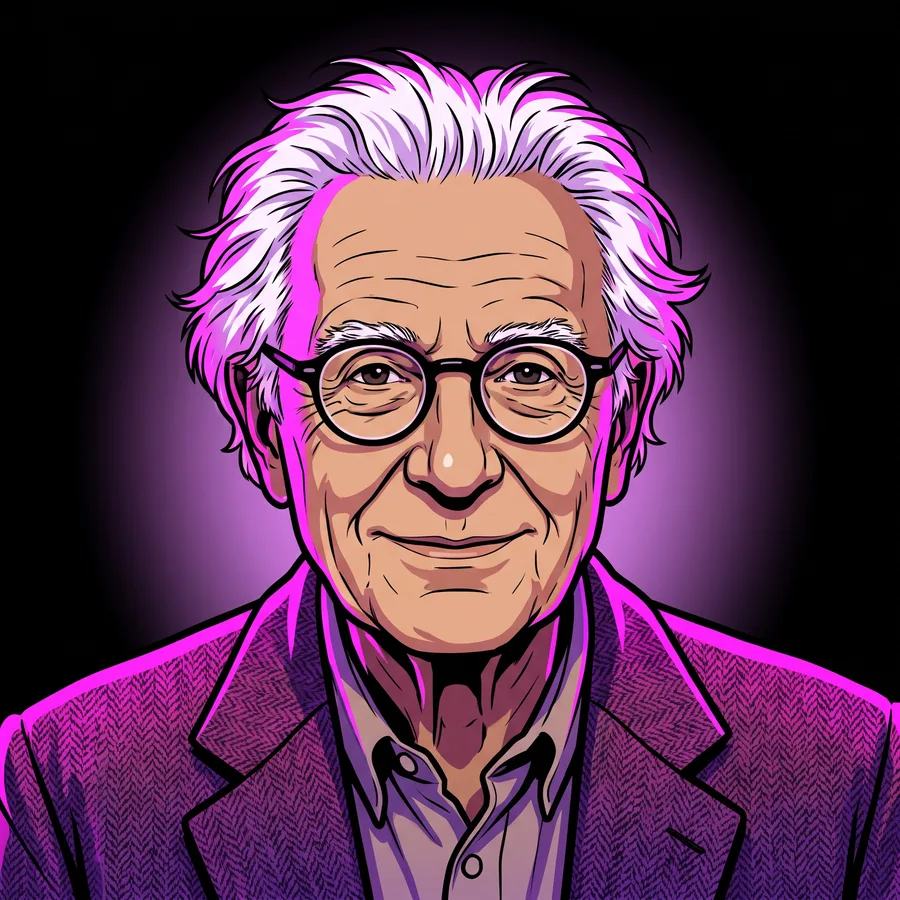
Some researchers spend decades working against the wind, without applause, in countries that don't even value them, and still manage to build something the world ends up using every day without knowing it. Vladimir Vapnik is one of them. Born on December 6, 1936, in Tashkent, in the Soviet Union, he spent much of his career developing statistical learning mathematics that nobody in the Eastern Bloc took seriously, while the AI field chased other fashions. When he finally emigrated to the United States in 1991 and joined AT&T Bell Labs, he arrived with decades of accumulated work, ready to go off.
His best-known contribution is the Support Vector Machine (SVM). In 1992, together with Bernhard Boser and Isabelle Guyon, he presented at NeurIPS the algorithm that could separate complex data with optimal margins. In 1995, he and Corinna Cortes published the canonical paper "Support-Vector Networks," which introduced the soft margin and turned SVMs into the dominant classification tool for an entire decade. Before deep networks arrived, if you wanted a machine to recognize text, images, or biomedical signals, you used an SVM. That was Vapnik's.
But his legacy goes beyond one algorithm. The Vapnik-Chervonenkis (VC) theory, developed with Alexey Chervonenkis starting in the 1970s in the USSR, built the mathematical foundations of machine learning: how many examples a model needs to learn, why it generalizes, and when it fails. It is the kind of theory no one sees directly, but that holds up everything people do see. Vapnik later became a professor at Columbia University and Royal Holloway (University of London) and spent time at Facebook AI Research. His honors include the Kolmogorov Medal (2018), the IEEE John von Neumann Medal (2017), the Benjamin Franklin Medal (2012), and the BBVA Frontiers of Knowledge Award (2019, shared with Guyon and Scholkopf).
To me, Vapnik's lesson is not about algorithms, it is about a long perspective. He knew he was right about how learning machines should work. He wrote it, published it for years in languages the AI world barely read, and he waited. When the world needed his ideas, they were there. Today, when you ask Claude to classify something, organize a text, or find patterns, there is a chain of tools that at some point draws from the mathematics of this man who spent decades in the dark without letting go of the thread.
Official links for Vladimir Vapnik, The father of machines that learn to classify
More figures who shaped AI in AI Legends, or back to the news.