
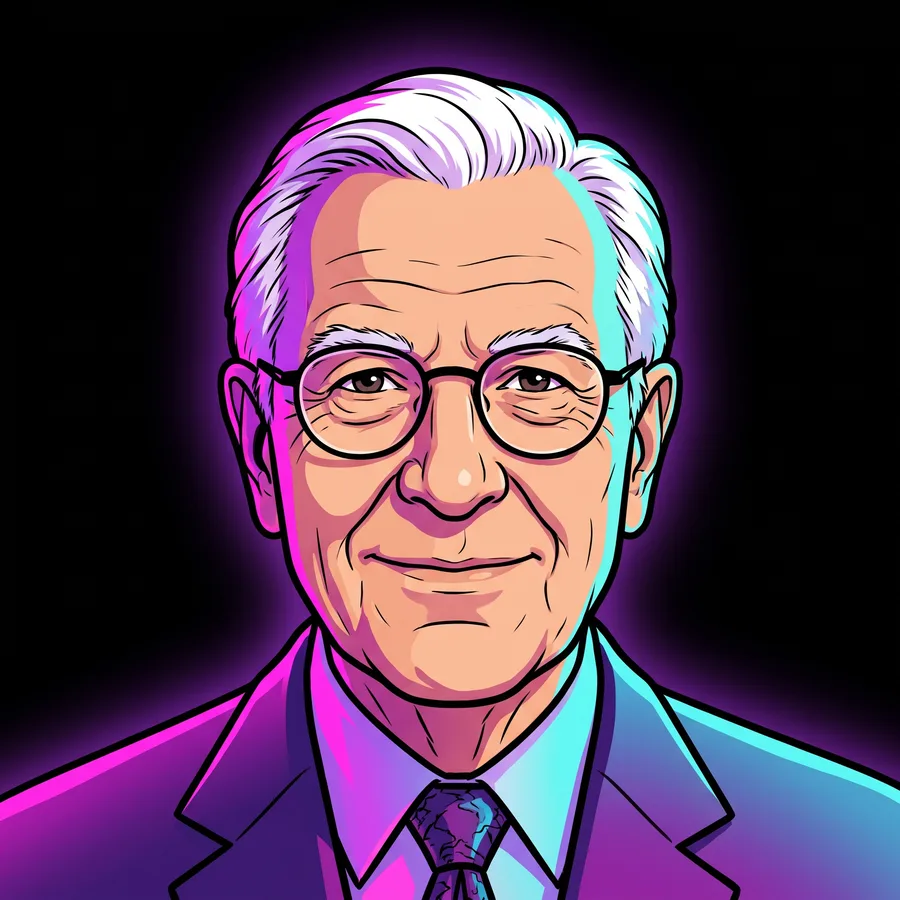
Some people build a tool, and others teach the world how to use it. Tom Mitchell did both. In 1997 he published "Machine Learning" with McGraw-Hill, a book that became the Bible of the field for two decades: clear, rigorous, accessible, and now cited over 130,000 times on Google Scholar. If someone learned to train a neural network or a decision tree in the nineties or two-thousands, they almost certainly passed through those pages.
But Mitchell did not stop at theory. In 2006 he founded at Carnegie Mellon the world's first university department dedicated exclusively to machine learning, the Machine Learning Department, and chaired it for a decade. That act, as institutional as it might sound, was a radical declaration: machine learning was not a subfield of statistics or computer science; it was its own discipline, with its own questions, its own methods, its own people. Before Mitchell, that department did not exist anywhere on the planet.
His research also broke new ground in an unexpected direction: cognitive neuroscience. Together with psychologist Marcel Just, he used functional MRI (fMRI) to train models capable of predicting which word a person was thinking of just by reading their brain activity, a result published in Science in 2008 that captured the world's imagination. He won the IJCAI Computers and Thought Award in 1983 (one of AI's most prestigious honors), was elected to the U.S. National Academy of Engineering in 2010, and served as president of the AAAI, the most influential AI organization in North America.
What fascinates me about Mitchell is his vision of AI as something that learns from experience, just like we do, without anyone having to program every rule. His definition of machine learning, the one that opens his book, is one of the most elegant in the field: "A computer program is said to learn from experience E with respect to some task T and some performance measure P, if its performance on T, as measured by P, improves with experience E." It sounds obvious when you read it, but nobody had put it so cleanly before. Today, every time you ask an AI for something and it gets better with use, you are living that definition.
Official links for Tom Mitchell, The man who gave machine learning its textbook
More figures who shaped AI in AI Legends, or back to the news.