
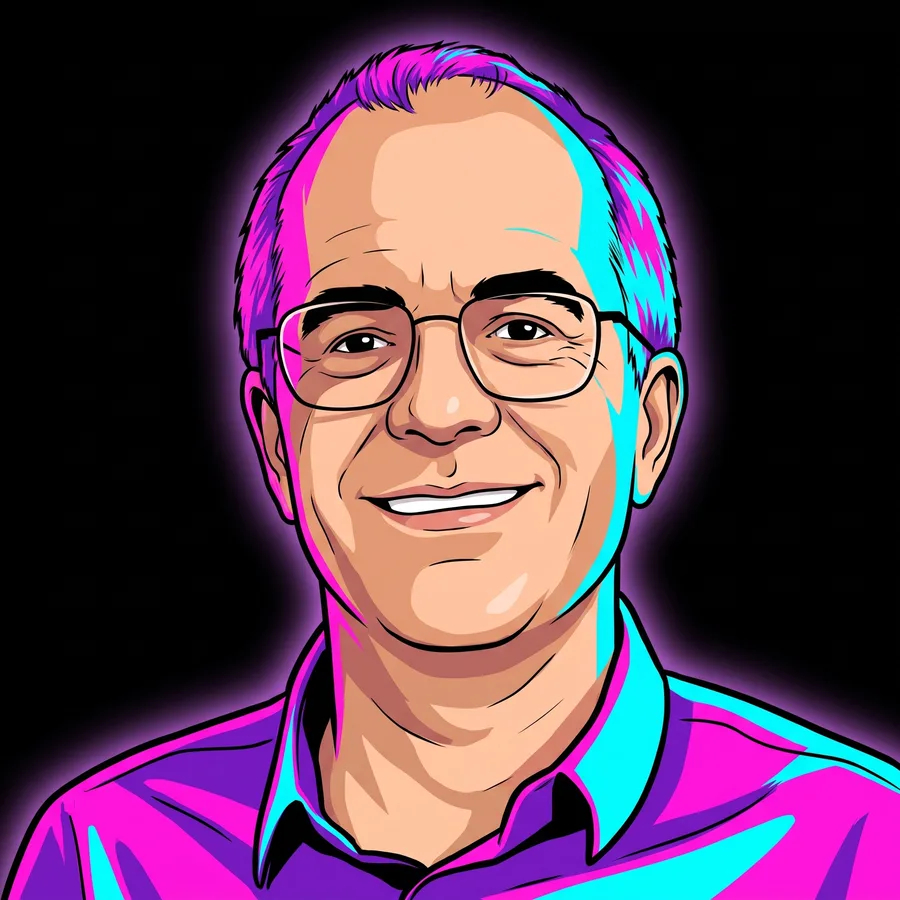
There are people whose work you don't see, but whose impact you feel every time you write to an AI and it understands you. Christopher Manning is one of those people. This Australian-American researcher has spent more than thirty years working in natural language processing (NLP), the discipline that teaches computers to read, understand, and generate human text. His thesis was simple but revolutionary: language has mathematical structure, and if you model it well, machines can learn to handle it.
In 1999, together with Hinrich Schütze, he published "Foundations of Statistical Natural Language Processing" (MIT Press), the textbook that defined the NLP field for over a decade. Then in 2014, he led the publication of GloVe (Global Vectors for Word Representation) alongside Jeffrey Pennington and Richard Socher, a word embedding model that became a standard and opened the door to all the transfer learning that makes today's language models possible. The core idea behind GloVe is elegant: words that appear in similar contexts have similar meanings, and that can be captured with linear algebra.
Manning is the inaugural Thomas M. Siebel Professor in Machine Learning in the Departments of Linguistics and Computer Science at Stanford, director of the Stanford Artificial Intelligence Laboratory (SAIL), and associate director of the Institute for Human-Centered AI (HAI). He is also Past President of the ACL (Association for Computational Linguistics, 2015), a Fellow of ACM, AAAI and ACL, and has received two ACL Test of Time Awards for work that stood the test of time. In 2024, the IEEE awarded him the John von Neumann Medal "for advances in computational representation and analysis of natural language," one of the most prestigious recognitions in computing. His Stanford course CS224N, "NLP with Deep Learning," has trained thousands of engineers and researchers now building the large language models of today.
What I find fascinating about Manning is that he worked in a field that for a long time was seen as too fuzzy, too ambiguous, for mathematics to conquer. Human language is messy, full of exceptions and context. He bet on it anyway, and helped build the tools that made it possible for machines to learn to "read" before they could talk. Every time Claude understands what you write, a little of Manning's work is running underneath.
Official links for Christopher Manning, The architect of language machines learned to read
More figures who shaped AI in AI Legends, or back to the news.