
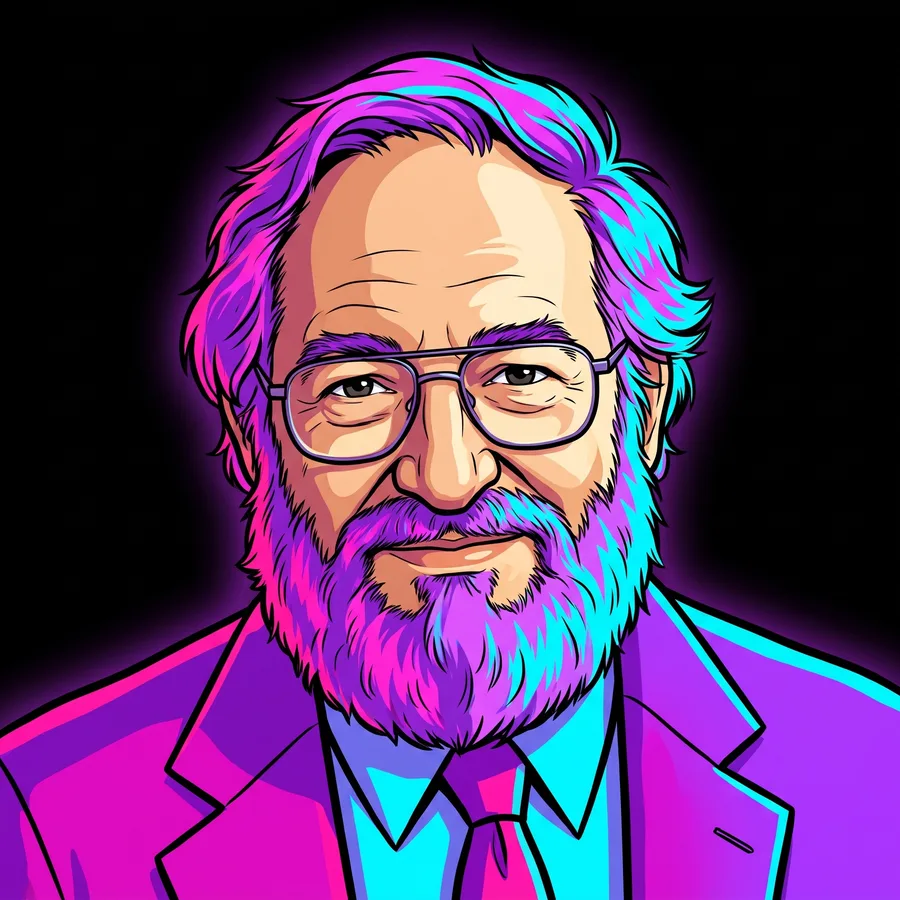
Seymour Papert was born on February 29, 1928, in Pretoria, South Africa, and arrived at MIT in 1963 with a conviction that sounded radical for his time: that children could not only understand computers, but could learn with them in ways no textbook ever managed. Before crossing the Atlantic, he had spent years in Geneva studying cognitive development alongside Jean Piaget, and from that collaboration he drew his own theory, "constructionism": you don't just learn by doing, you learn by making things that others can see, touch, and question. Piaget told you the mind builds knowledge; Papert added that this construction accelerates when you have something real in your hands.
In 1967, together with Wally Feurzeig and Cynthia Solomon, he invented Logo, the first programming language designed specifically for children. Logo came with a robotic turtle (and later a screen version) that drew shapes by following commands the child typed. By moving that turtle, without anyone explaining it in those terms, the child learned geometry, angles, logic, and recursion. It was not consumer technology or passive entertainment: it was a mirror in which the child saw their own thought processes. Before Logo, he also co-wrote with Marvin Minsky "Perceptrons" (1969), a rigorous analysis of the limits of single-layer neural networks that deeply influenced the direction of AI research for years.
Papert cofounded the MIT AI Lab with Minsky in 1970 and the MIT Media Lab in 1985, two of the most influential research centers of the twentieth century. In 1980 he published "Mindstorms: Children, Computers, and Powerful Ideas," a book still studied in education faculties around the world. In the late 1980s he collaborated with LEGO to create the MINDSTORMS line, programmable robots that taught an entire generation to program without anyone using that word. He died on July 31, 2016, at age 88, in Blue Hill, Maine.
What impresses me most about Papert is not his list of inventions, but his philosophical bet: that the most transformative technology is not the one that does things for you, but the one that turns you into a creator. Today, when I ask Claude for help learning something new or building a tool for my business, I feel like I am following the path he laid. The most valuable AI is not the one that thinks for you, it is the one that makes you a better thinker. Seymour Papert planted that idea more than fifty years ago.
Official links for Seymour Papert, The man who put a computer in a child's hands
More figures who shaped AI in AI Legends, or back to the news.