
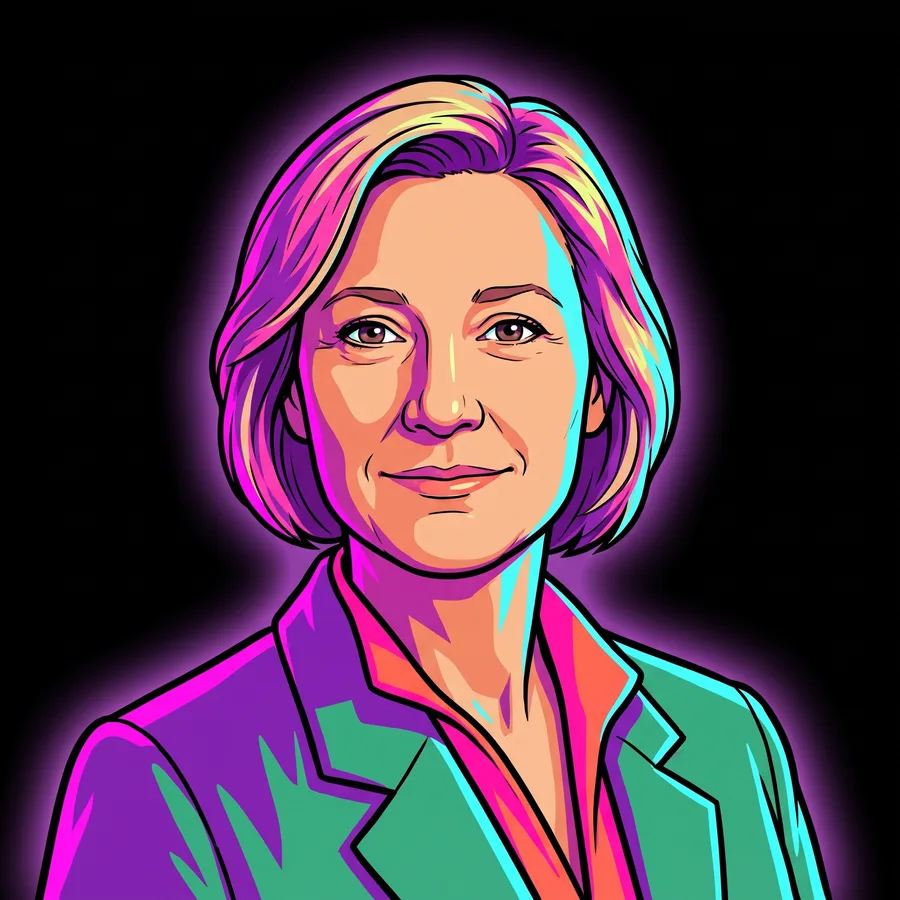
Rosalind Picard made a bet in 1994 that sounded almost philosophical at the time: that computers needed to understand emotions in order to become truly useful. In a field ruled by pure logic and cold algorithms, this MIT engineer argued that a machine without access to our emotional state could never truly communicate with us. Her colleagues raised eyebrows. She kept going.
In 1997 she published "Affective Computing" (MIT Press), the book that formally founded a new discipline. The argument was concrete and bold: if we want technology to serve us better, it has to learn to read signals like stress, frustration, or joy. That work made her the director of the Affective Computing Research Group at the MIT Media Lab, where she has developed wearable sensors and algorithms now applied in mental health, autism, epilepsy, and sleep diagnostics. In 2013 she co-founded Empatica alongside a team of researchers, a company that developed Embrace: a wristband capable of detecting seizures. In January 2018, Embrace received FDA clearance, becoming the first medical smartwatch with that seal for managing epilepsy.
Picard studied electrical engineering at Georgia Tech with highest honors, then completed her master's and doctorate at MIT itself. In 2005 she was named an IEEE Fellow for her contributions to image and video analysis and affective computing. In 2019 she was elected to the National Academy of Engineering, one of the highest honors in her field, and in 2021 she joined the National Academy of Inventors and became an ACM Fellow. In 2022 she received the International Lombardy Prize for Computer Science Research.
What strikes me most about Rosalind Picard isn't just the technology: it's that she reminded the world that a person whose emotions a machine cannot detect ends up left behind by progress. Every time a mental health app asks how you're feeling, there is a direct thread back to her work. And the next time you use Claude to talk through something difficult and notice that tone matters as much as the words, think of her.
Official links for Rosalind Picard, The inventor who taught machines to feel
More figures who shaped AI in AI Legends, or back to the news.