
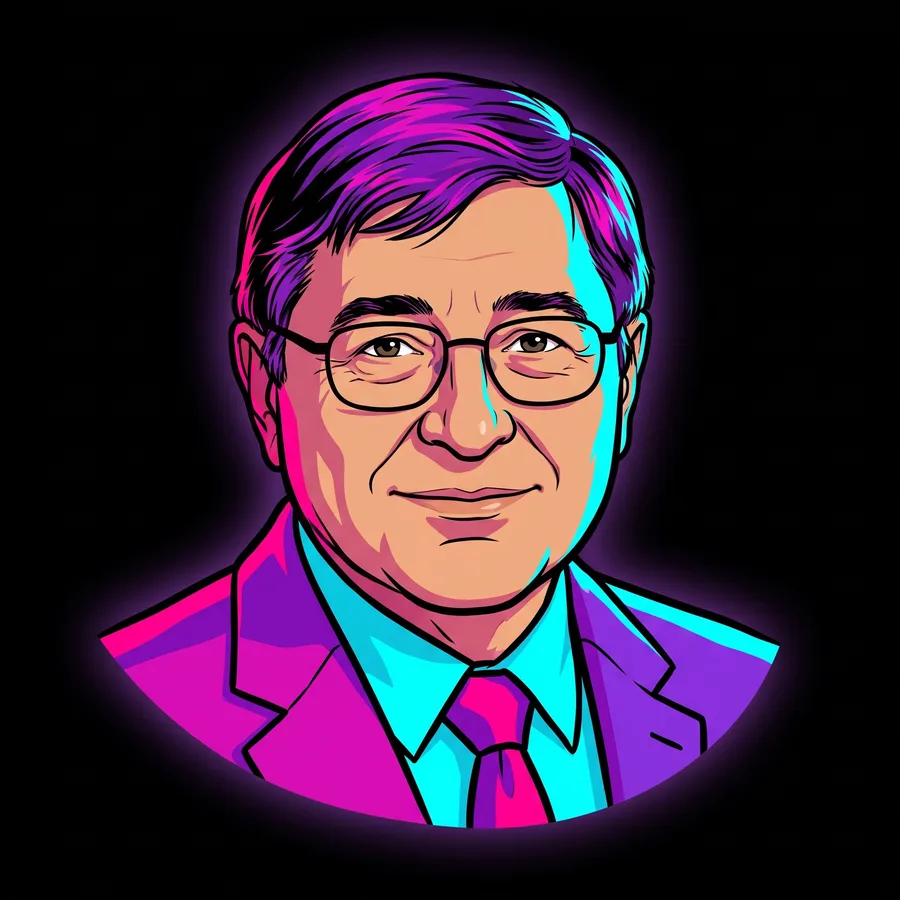
Judea Pearl is an Israeli-American computer scientist who did something few in artificial intelligence dared: asking machines not just "what happened?" but "why did it happen?" and "what would have happened if...?". Born in Tel Aviv in 1936, he came to the United States to study engineering and ended up at UCLA in 1970, where he spent decades convinced that the difference between an intelligent machine and a sophisticated calculator lay in causality, not just data. In a field obsessed with correlation, he bet on something more ambitious: teaching computers to reason about causes and consequences.
In the 1980s, when AI depended on hand-written rules, Pearl developed Bayesian networks, a mathematical model that enables probabilistic reasoning under uncertainty. His book "Probabilistic Reasoning in Intelligent Systems" (1988) became a cornerstone of the field. But his deepest contribution came later: the "do-calculus," a formal language for distinguishing correlation from real cause. With "Causality: Models, Reasoning, and Inference" (2000) and the popular science book "The Book of Why" (2018, with Dana Mackenzie), he put into words what researchers didn't know how to say: that data alone is never enough to understand the world. Observing that hospitals have more deaths doesn't mean hospitals kill. Reasoning about that, with mathematical rigor, was exactly what AI needed.
In 2011 he received the Turing Award, computing's highest honor, "for fundamental contributions to artificial intelligence through the development of a calculus for probabilistic and causal reasoning." He has spent more than five decades at UCLA, where he directs the Cognitive Systems Laboratory. Beyond academic accolades, Pearl's life carries a human layer that few know: in January 2002, his son Daniel Pearl, a Wall Street Journal journalist, was kidnapped and murdered in Pakistan. Judea and his family founded the Daniel Pearl Foundation that same year, dedicated to intercultural dialogue and free journalism.
Pearl's lesson for me is about intellectual honesty. Today's AI models are extraordinarily good at correlating, but Pearl has spent decades asking out loud whether that is enough to truly understand. Every time you ask Claude "why did this happen?" or use an AI tool to make an informed decision, there is an echo of Pearl's work reminding us that data doesn't speak for itself: you have to ask it the right questions.
Official links for Judea Pearl, The father of causality in AI
More figures who shaped AI in AI Legends, or back to the news.