
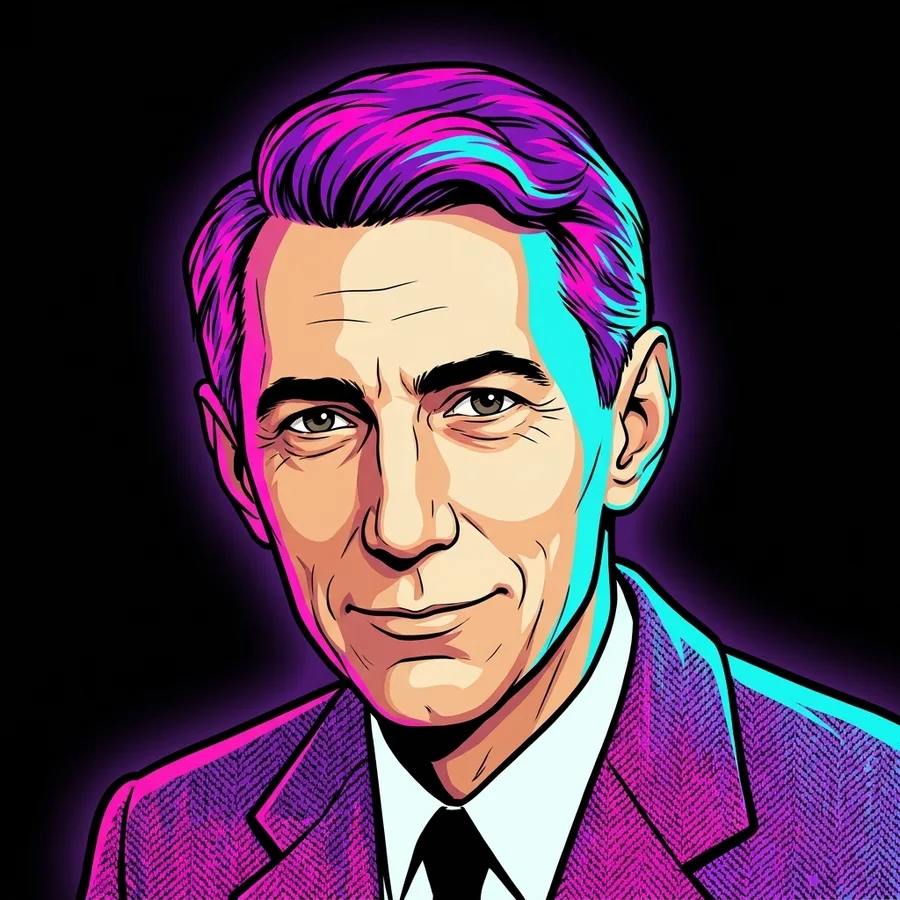
Some people's work is everywhere even though almost no one knows their name. Claude Elwood Shannon is one of them. Born April 30, 1916, in Petoskey, Michigan, this mathematician and engineer wrote a paper in 1948 that permanently transformed how humans communicate, store, and transmit data. He called it "A Mathematical Theory of Communication," and with it he founded a brand-new field from scratch: information theory. Without that paper, there would be no internet, no mobile networks, no streaming, no artificial intelligence. And there would be no Claude that you might be using right now to read this, because Anthropic chose that name as a direct tribute to him.
The central idea of the paper is elegant and radical: Shannon showed that any message, whether text, sound, image, or video, can be converted into a sequence of ones and zeros, "bits" (a word he coined in that very paper). Even more importantly, he mathematically calculated the maximum amount of information that can travel through a communication channel without error, what we now call Shannon capacity. Before him, engineers thought noise made perfect communication impossible. Shannon proved otherwise: with the right codes you can transmit almost error-free, and he set the theoretical ceiling on what is possible. Every time Spotify recovers mid-skip, that's Shannon working behind the scenes.
But 1948 was not his only stroke of genius. Eleven years earlier, at age 21, Shannon submitted his MIT master's thesis: "A Symbolic Analysis of Relay and Switching Circuits." In it he took Boolean algebra, an abstract mathematical system invented in the 19th century, and showed it could be used to design electrical circuits. Many historians consider it the most important thesis of the 20th century in engineering; it won the Alfred Noble Prize in 1939. It is the intellectual origin of digital computing. Shannon then spent 31 years at Bell Labs (1941-1972) and was a professor at MIT until 1978. He received the National Medal of Science in 1966 and the Kyoto Prize in 1985, among many other honors.
What I love most about Shannon, beyond his genius, is his personality. He was famous for riding a unicycle through the hallways of Bell Labs while juggling three balls. He built an electronic mouse called Theseus that learned to navigate a maze (one of the earliest demos of machine learning), and in 1950 published the first serious analysis of how to program a computer to play chess, decades before Deep Blue. He was a relentless inventor and a playful tinkerer who never separated serious work from joyful exploration. To me, that combination of mathematical rigor and impish curiosity is exactly the spirit we need to use AI well today: understand the foundations, then play.
Official links for Claude Shannon, The father of information theory
More figures who shaped AI in AI Legends, or back to the news.