
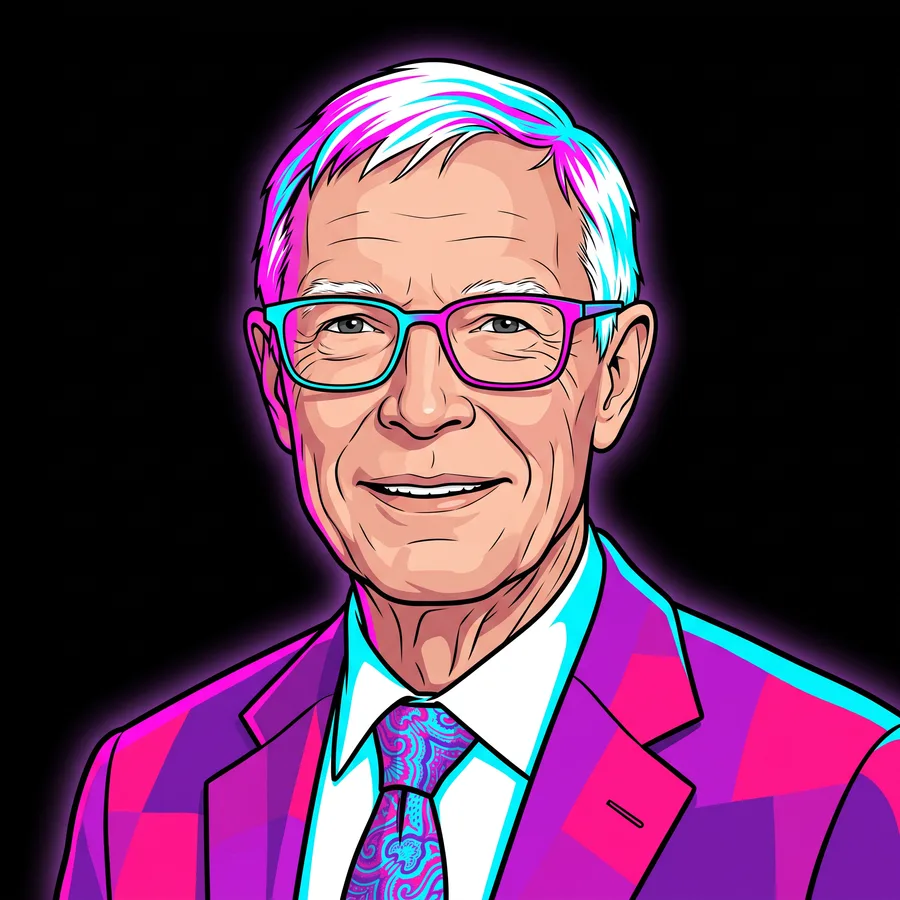
John Hopfield isn't the typical artificial intelligence pioneer. He didn't come from computing or linguistics: he was a physicist, a student of materials and quantum systems. But in the late 1970s he started asking a question that crossed all those boundaries: if the brain can store memories and recover them even when they're incomplete or distorted, what does the brain have that a mathematical network couldn't have? That question changed everything.
In 1982 he published his answer: the Hopfield network. The brilliance of his idea was taking a concept from physics, the minimum energy of a system of magnetic spins, and applying it to interconnected nodes that represent neurons. Each time the network receives a corrupted or incomplete image, it adjusts its states step by step, "downhill" in the energy landscape, until it finds the pattern that best matches what it learned. In simple terms: the network remembers. Not like a database searching by index, but like a brain filling in what's missing. That associative memory principle was so powerful that Hinton used it as the foundation to develop Boltzmann machines, the direct link to modern deep learning.
Hopfield spent time at Bell Labs, at Princeton's Institute for Advanced Study, and at Caltech, where he developed his most famous network. He spent decades doing basic research that many in computing didn't follow closely. But in 2024 the world returned the recognition: the Swedish Academy awarded him the Nobel Prize in Physics, shared with Geoffrey Hinton, "for foundational discoveries and inventions that enable machine learning with artificial neural networks." It was the first time the Physics Nobel recognized work with such direct roots in modern AI.
The lesson Hopfield leaves me with is about the fertility of crossing boundaries. Nobody in the AI field of the 1980s expected a materials physicist to arrive with the idea that would move the whole field. Precisely because he came from outside, he saw something the others didn't: that a brain and a magnet can behave in surprisingly similar ways. Today, every time you use an AI tool that generates text, recognizes a face, or autocompletes something for you, there's a bit of that curious Princeton physicist working underneath.
Official links for John Hopfield, The physicist who taught the network to remember
More figures who shaped AI in AI Legends, or back to the news.