
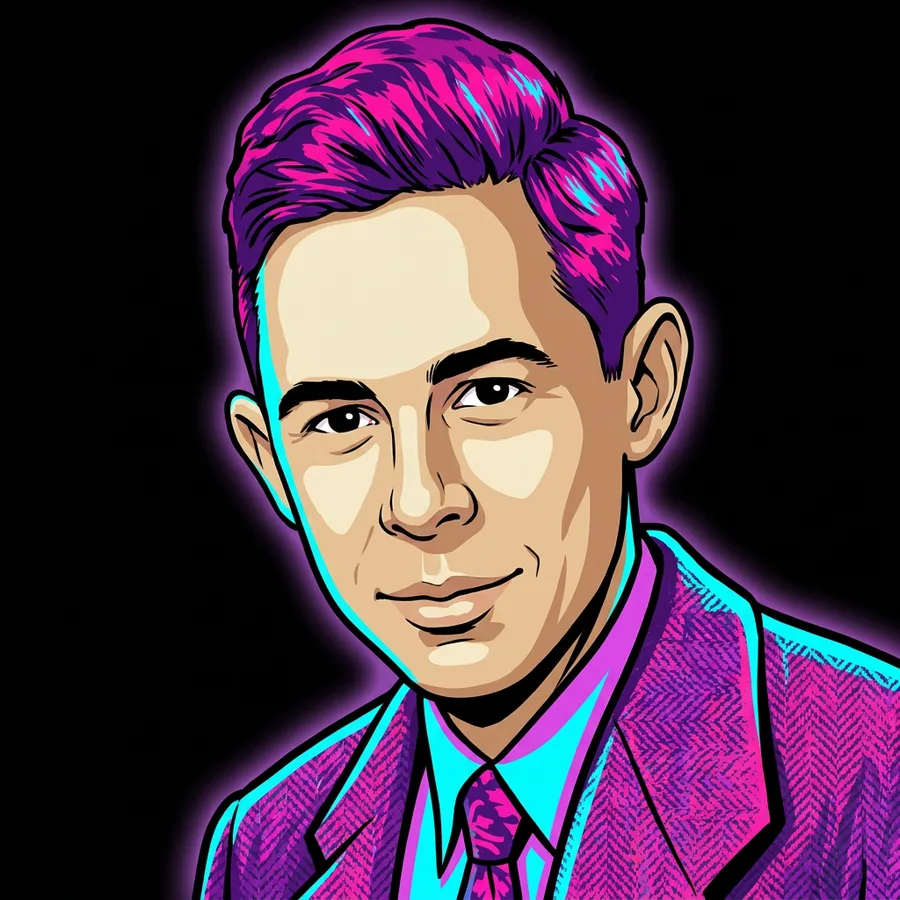
Before ChatGPT existed, before anyone had uttered the words "deep learning," a psychologist from New York named Frank Rosenblatt sat in front of a room-sized computer and asked a radical question: can a machine learn on its own? In 1957, at the Cornell Aeronautical Laboratory in Buffalo, he simulated on an IBM 704 something he called the perceptron. It wasn't elegant software or a mysterious algorithm: it was an idea born from biology, from how neurons in the brain connect and adjust through experience. The machine could distinguish cards marked on the left from cards marked on the right, and it improved on its own with each attempt. It was 1957. No one yet knew what they were looking at.
In 1958 he published his founding paper: "The Perceptron: A Probabilistic Model for Information Storage and Organization in the Brain," in Psychological Review. And in 1960 he built something physical: the Mark I Perceptron, a machine described as the first computer capable of learning new skills by trial and error using a network that mimicked human thought. The Mark I now rests at the Smithsonian Institution, a relic of everything that came before. In 1962 he gathered his ideas into a book, "Principles of Neurodynamics," still cited today.
His career was not a straight line of victories. Neural networks fell out of favor in the 1970s after Minsky and Papert demonstrated the limitations of the simple perceptron in their 1969 book "Perceptrons." But Rosenblatt did not live to see that winter: he died on July 11, 1971, in a boating accident on Chesapeake Bay, on his 43rd birthday. The Institute of Electrical and Electronics Engineers (IEEE) honored him in 2004 by creating the Frank Rosenblatt Award, given each year to those who advance biologically-inspired learning systems.
What moves me about Frank Rosenblatt is not only what he invented, but when he did it and without knowing the size of what he was planting. He believed the brain could be a model for machines at a time when almost everyone thought intelligence was just logic, rules, and symbols. He died young, without seeing the revolution he ignited. Every time a neural network recognizes your voice, your face, or the text you type to it, there is a spark of that 1957 perceptron working somewhere underneath.
Official links for Frank Rosenblatt, The man who taught a machine to learn
More figures who shaped AI in AI Legends, or back to the news.