
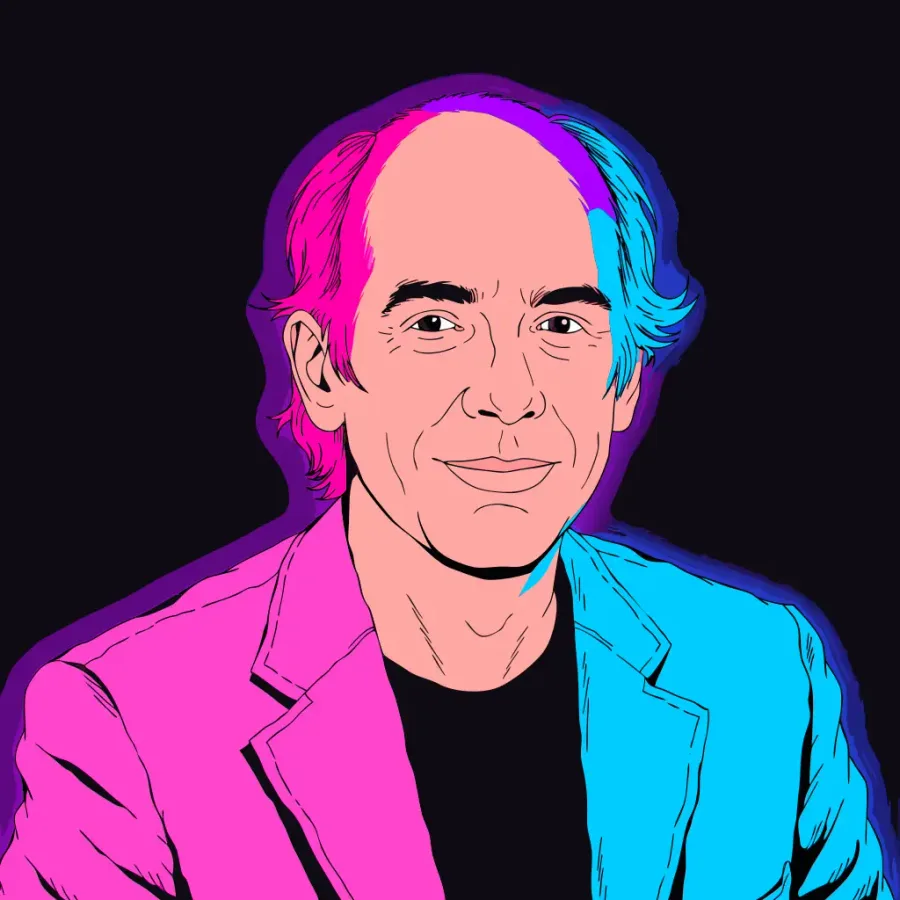
Some people change an entire field and the world barely notices. David Rumelhart was one of them. Trained as a cognitive psychologist, he was not an engineer or mathematician in the classic sense, but he was obsessed with a question: can a machine learn to recognize patterns the same way the human brain does? In the 1970s and 1980s, when the fashion in artificial intelligence was symbolic logic and explicit rule systems, that question was almost heretical. Rumelhart and his group at UC San Diego pursued it anyway.
In 1986, alongside Geoffrey Hinton and Ronald Williams, he published "Learning Representations by Back-propagating Errors" in the journal Nature. That paper popularized the backpropagation algorithm: the mechanism that lets a neural network calculate its own error and adjust its connections layer by layer until it improves. This is essentially the same technique that today trains ChatGPT, image generation models, and Claude. That same year, together with James McClelland, he published the monumental "Parallel Distributed Processing" (PDP), two volumes that became a foundational text in computational cognitive science and showed how human thought could be modeled with networks of interconnected nodes.
His career spanned more than two decades at UC San Diego (1967-1987) and Stanford University (1987-1998). In 1987 he received a MacArthur Fellowship, commonly known as the "Genius Grant." In 2002, the University of Louisville awarded him and McClelland the Grawemeyer Award in Psychology for their parallel distributed processing work. By 2001, however, at the age of 59, he was diagnosed with a devastating form of frontotemporal dementia called Pick's disease, which slowly dimmed his mind. He passed away on March 13, 2011, at the age of 68. The cognitive science community honored his memory by creating the David E. Rumelhart Prize, awarded annually for outstanding contributions to the formal modeling of human cognition.
To me, Rumelhart's story is one of the most important, and also one of the most undersung, in the history of AI. His contribution was not just technical: it was one of perspective. He insisted that understanding artificial intelligence required first understanding natural intelligence, and that path took him somewhere that seemed marginal until, suddenly, it was at the center of everything. Every time you message Claude, or an app recognizes your face or your voice, there is an invisible thread that leads back to that 1986 paper and to the curious stubbornness of a psychologist who believed in neural networks when almost no one else would look at them.
Official links for David Rumelhart, The man who taught machines to learn
More figures who shaped AI in AI Legends, or back to the news.