
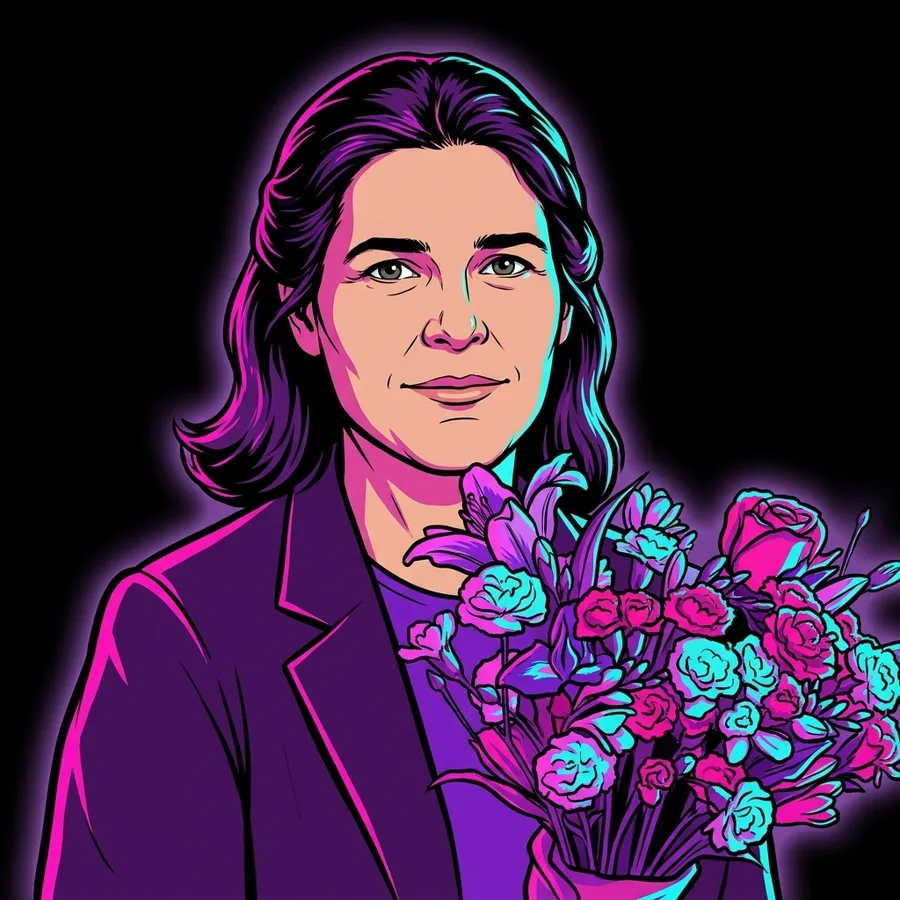
Some scientists change a field. And some scientists change how the world learns. Daphne Koller, born in Jerusalem in 1968 and educated at the Hebrew University before earning her PhD at Stanford, managed to do both. Her Stanford career began in 1995, and for nearly two decades she became one of machine learning's clearest voices: her area was reasoning under uncertainty, that capacity to make good decisions when you don't have all the data. The textbook she co-authored with Nir Friedman, "Probabilistic Graphical Models" (2009), remains the definitive reference in the field.
In 2001 she received the IJCAI Computers and Thought Award, the most coveted recognition for young AI researchers. In 2004 the MacArthur Foundation selected her for its "genius" fellowship (the one you don't apply for, it finds you). But the moment that made her visible to the whole world came in 2012, when together with Andrew Ng she co-founded Coursera, the platform that brought Stanford courses to more than a hundred million people. It wasn't just technology: it was a statement that university knowledge should not be a privilege reserved for those who could pay tuition.
In 2018 she made another surprising pivot: she left academia to found Insitro, a company in South San Francisco where she applies machine learning to drug discovery and development. The idea is simple but powerful: if you can model biology as a system of structured uncertainty, you can find patterns that human scientists would take decades to detect. By 2023 she was already a member of the National Academy of Sciences, adding to her memberships in the National Academy of Engineering (2011) and the American Academy of Arts and Sciences (2014).
What inspires me about Daphne Koller is that she never stayed where it was comfortable. Stanford was comfortable. Coursera, once it was successful, was comfortable. She kept moving toward where she believed AI could do something truly important. That intellectual restlessness, that refusal to settle for applause, is exactly what AI lets us emulate today: asking ourselves what real problem we can tackle with the tools we have.
Official links for Daphne Koller, The woman who brought the university to the world
More figures who shaped AI in AI Legends, or back to the news.