
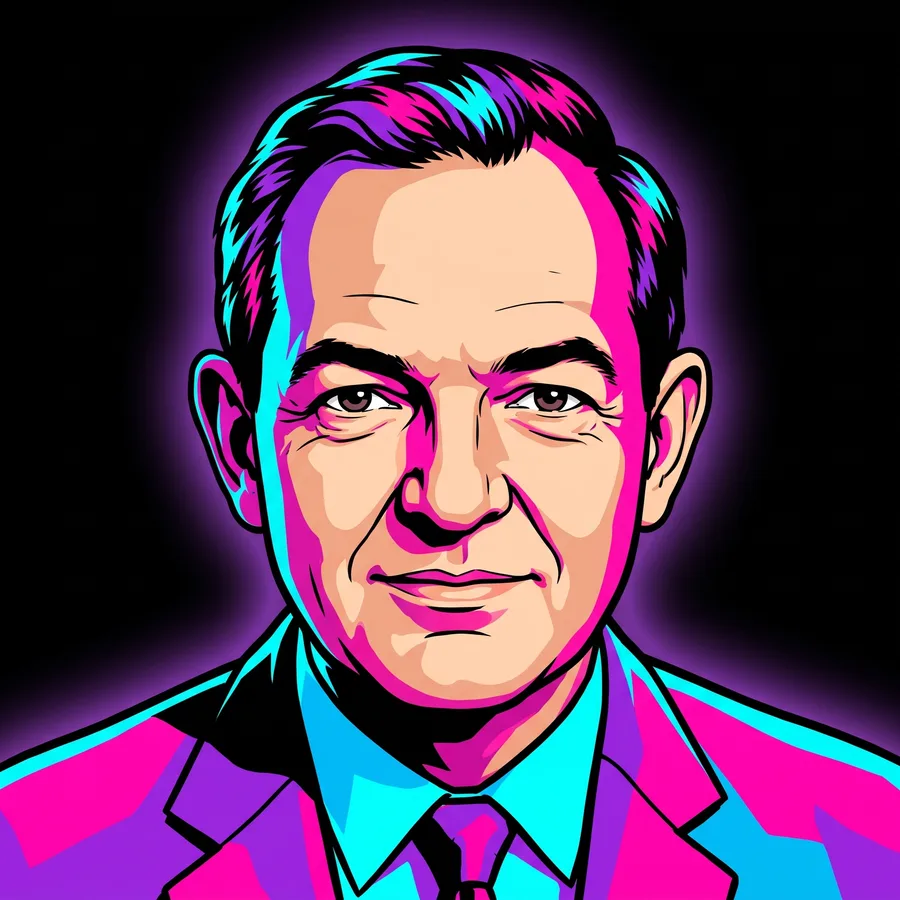
Some people arrive before the words exist to describe what they are doing. Allen Newell was one of them. In 1955, working at the RAND Corporation in Santa Monica alongside Herbert Simon and programmer J. Clifford Shaw, he began building something the world didn't yet know how to name: a computer program that could prove mathematical logic theorems on its own. They called it the Logic Theorist, and it was finished in 1956, right as the term "artificial intelligence" was being coined that same summer at the Dartmouth conference. Newell and Simon already had the product before the concept existed.
The Logic Theorist wasn't a trick or a pre-loaded table of results: it was a program that reasoned. It ran on RAND's JOHNNIAC computer and proved 38 of the first 52 theorems in Chapter 2 of Whitehead and Russell's Principia Mathematica, in some cases finding shorter proofs than the ones in the original book. A year later, in 1957, Newell, Simon, and Shaw went even further with the General Problem Solver (GPS): a system designed to solve any well-defined problem using means-ends analysis, comparing the current state to the goal and searching for operations to close the gap. Logic, geometry, chess: GPS would try it all.
In 1961 Newell moved to Carnegie Mellon University, where he would spend the rest of his life and help found one of the world's first Computer Science departments. In 1975 he and Simon received the Turing Award, the "Nobel of computing," with the official citation: "for their basic contributions to artificial intelligence and the psychology of human cognition." Their acceptance lecture introduced the Physical Symbol System Hypothesis, the idea that any system that properly manipulates symbols has what is necessary and sufficient to exhibit general intelligence. It was a bold claim that shaped decades of debate in AI. In the 1980s Newell developed SOAR, a cognitive architecture capable of creating its own subgoals and learning from its own experience. His final book, "Unified Theories of Cognition" (1990), based on his William James lectures at Harvard, attempted something grand: a unified theory of how the human mind works.
Newell died in 1992 at age 65, without seeing the neural network explosion that would transform his field. But every time an AI model breaks a problem into steps, sets a goal, and works toward it, there is a direct echo of the principles he and Simon put on paper seven decades ago. What strikes me most about him isn't just the technical brilliance, but the ambition of the question: not "can a machine play chess?" but "can a machine think, in the most general and profound sense of that word?" That question is still ours today, and we ask it with much better tools, but he was among the first to take it seriously.
Official links for Allen Newell, The architect who taught machines to reason
More figures who shaped AI in AI Legends, or back to the news.