
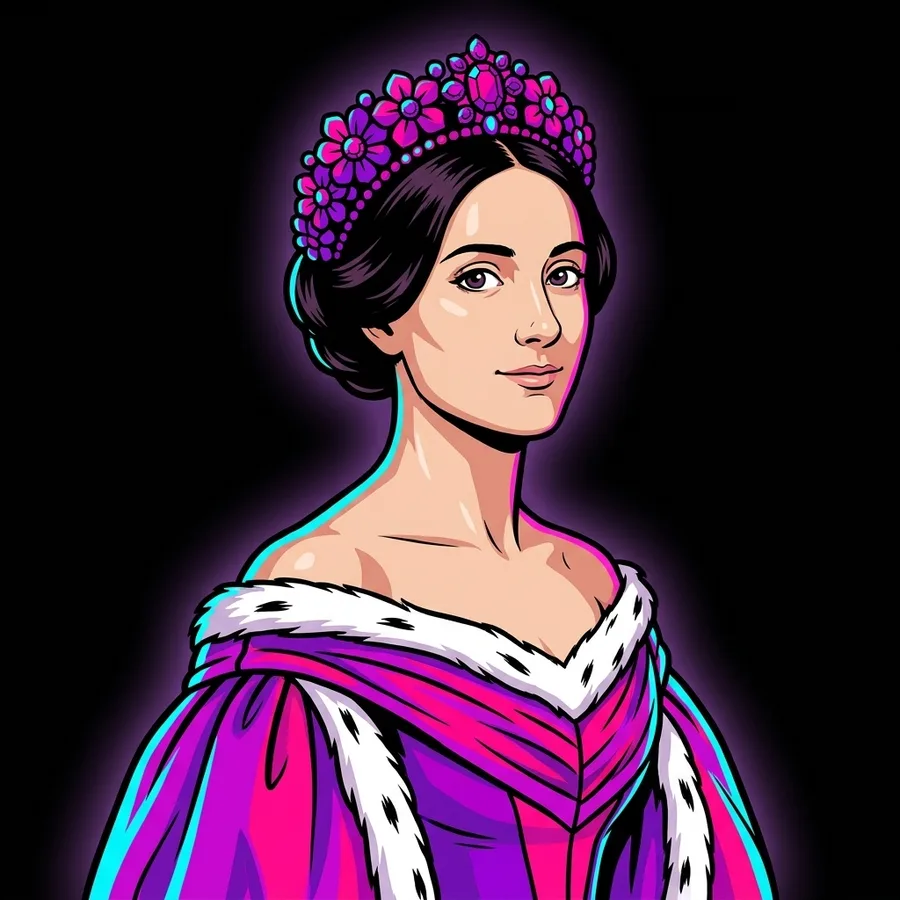
Ada Lovelace grew up in Victorian England without ever knowing her father, the poet Lord Byron, who left the family when she was barely a month old. Her mother, Annabella Milbanke, made an unusual decision for the era: she had Ada tutored in mathematics, convinced that science would steer her away from Byron's impulsive, artistic nature. What Annabella did not anticipate was that Ada would absorb poetry and mathematics in equal measure, and that this rare combination would change history. At a time when women had almost no access to scientific circles, Ada found a way in, and a way to leave a mark that would last for centuries.
In 1842, when Ada was 27, an Italian mathematician named Luigi Menabrea published an article in French about Charles Babbage's Analytical Engine, a conceptual mechanical computer that was never fully built. Ada translated the article into English, but she went much further: she added her own notes that were three times longer than the original. Within those notes, her "Note G" laid out step by step how the machine could calculate Bernoulli numbers, a complex mathematical sequence. That set of instructions is now recognized as the first computer algorithm in history. But even more significant was that Ada grasped something Babbage himself had not fully seen: this machine was not just a calculator. It could manipulate any symbol, compose music, and process any kind of information that could be represented in notation.
The Ada programming language, created by the United States Department of Defense in the 1980s, was named in her honor. Every October 13th, Ada Lovelace Day is celebrated internationally to highlight the contributions of women in science and technology. She died at 36 in November 1852, shortly after completing that landmark work, never seeing the impact of what she had imagined. Her vision of what a machine could become was more than a century ahead of the modern computing era.
To me, Ada Lovelace is proof that the most transformative ideas rarely arrive at the "right moment." She wrote about programming a machine that did not exist, for a field that had no name yet. That takes a particular kind of imagination: the kind that can see the future with the tools of the present. Today, every time you use Claude to solve something that once required an expert, you are exercising exactly the vision Ada articulated in 1843, that a machine can do far more than calculate.
Official links for Ada Lovelace, The world's first computer programmer
More figures who shaped AI in AI Legends, or back to the news.