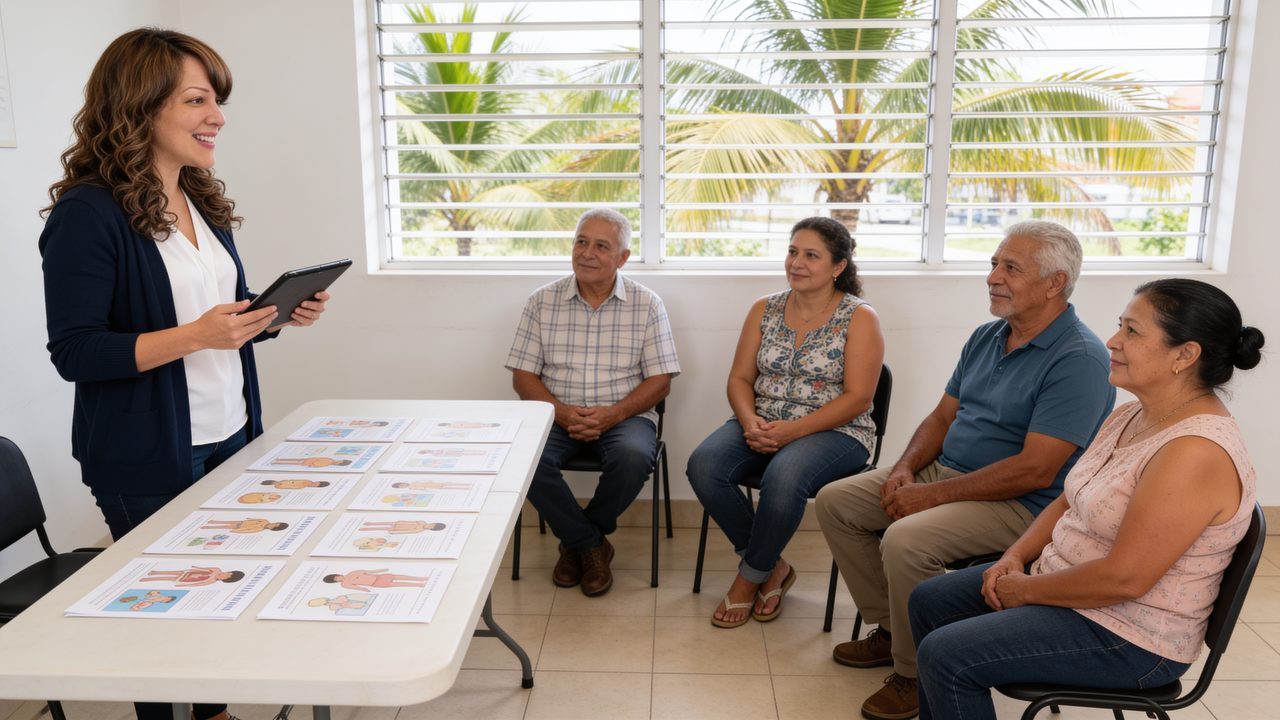
A community health worker’s job rarely fits inside an eight-hour schedule. Home visits, prevention workshops, follow-up records, the materials you need to print to explain to a family what diabetes is or how to prevent dengue… all of that adds up, and it almost always falls on a single person’s shoulders.
If you’re a community health worker, you know exactly what I mean.
Artificial intelligence won’t do the fieldwork for you. It can’t go on the visit, can’t build trust with a family, can’t read the body language of someone who’s afraid of a diagnosis. But it can help you with what happens before and after those visits: the materials, the documentation, and the communication.
What AI can do for a community health worker
With an AI like Claude or ChatGPT you can:
- Create educational materials in plain language: Describe the health topic and the community profile (approximate education level, language, context) and AI generates a handout, a fact sheet, or a workshop script that anyone can understand.
- Adapt materials for different audiences: The same hypertension topic needs different language for older adults than for young people. AI can make that adaptation in seconds.
- Document home visits: Give it the key points of what you observed and AI helps you organize that into a clear, complete record.
- Draft reports for the health center: With your data, AI helps you structure the monthly report or the indicator summary.
- Prepare answers to frequently asked questions: If the community always asks the same things about vaccines, a program, or a process, AI helps you prepare clear, verified answers.
A real example: materials for a prevention workshop
Imagine you have a workshop next week on type 2 diabetes prevention for older adults in a rural community. You need a simple handout, no jargon, that people can take home.
Here’s what you can do:
- Open an AI and describe your audience: “I need an educational handout on how to prevent type 2 diabetes. The audience is older adults in a rural area with basic education. Keep it simple, use examples of local foods, no technical terms.”
- Review the draft: AI gives you a text. You review it with your knowledge of the topic and the community, and adjust what doesn’t fit (a regional food it didn’t include, a stat that needs updating).
- Validate with medical staff: Before printing and distributing, run the material by the doctor or nurse at the health center. That step doesn’t change. AI doesn’t replace clinical review.
The process that used to take you hours of searching for materials, adapting them and formatting them is now dramatically faster. You’re still the one who decides what stays and what goes.
Documentation without losing the thread
After ten home visits in a week, remembering the details of each family becomes hard. AI can help you turn your quick notes into structured records.
For example: give AI your visit notes (“family of 5, mother with high blood pressure since last year, not taking medication regularly, young children, no consistent running water”) and it helps you turn that into a clear record with the fields your health center needs.
AI organizes the information. You contribute the direct observation that no system can capture.
What you shouldn’t delegate to AI
AI does not diagnose. It does not assess symptoms. It does not replace guidance from the doctor or health team.
If a family asks you specific clinical questions during a visit, the right answer is always to direct them to the health center, not to consult AI in that moment. AI is for preparing and documenting your work, not for replacing clinical judgment.
Always verify any materials you generate with the medical team before distributing them. Incorrect health content can cause harm.
Start with the material that takes you the most time to prepare
You don’t have to change your entire workflow this week. Choose the educational material that takes you the longest to prepare (that handout you always end up building from scratch) and hand it to an AI this week.
The time you save in preparation is time you can spend being more present in your fieldwork. And in your line of work, that makes all the difference.
Want these tools compared in depth? Check the unbiased reviews.