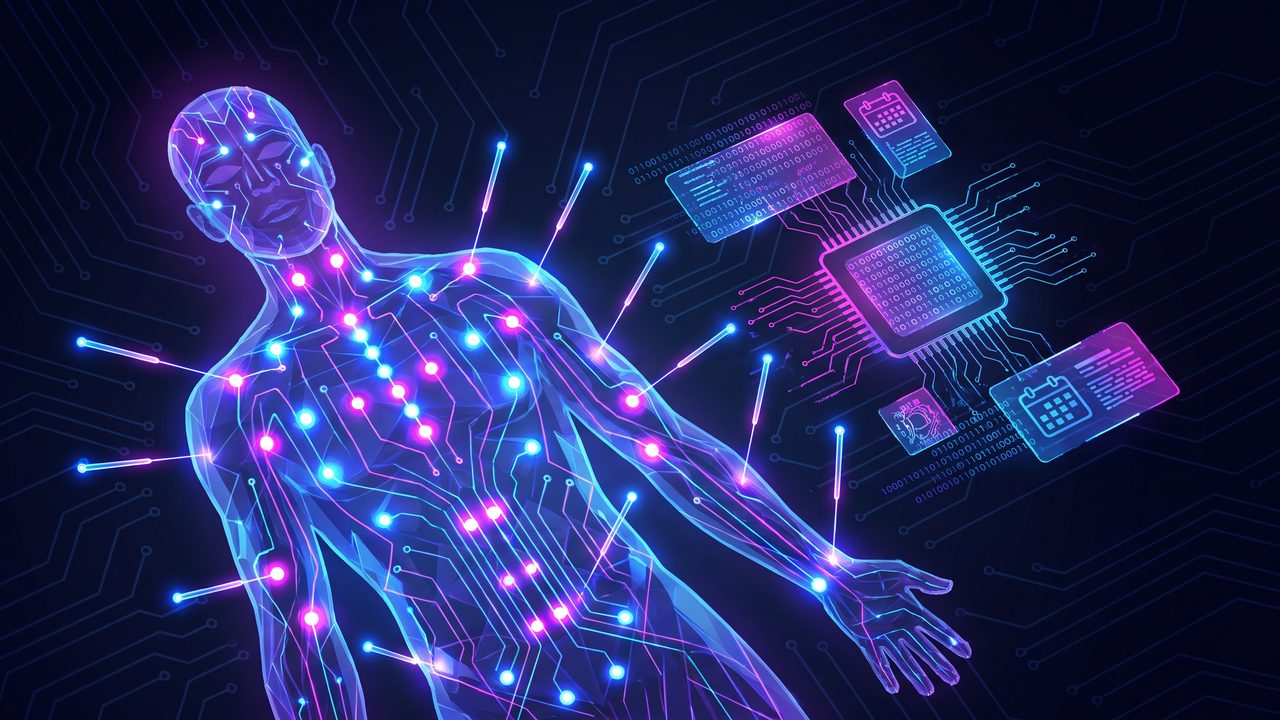
If you are an acupuncturist or practice traditional medicine, you know the heart of your work happens with the patient on the table: listening, reading the pulse, looking at the tongue, feeling where the imbalance is. But around that moment there is a mountain of tasks that drain your energy: writing notes, building plans, answering messages, juggling the schedule. That is where artificial intelligence can truly help you.
Let it be clear from the start: AI does not diagnose or touch your patient. It is an assistant for your drafts and your organization. Clinical judgment stays one hundred percent yours.
Session notes without staying late
After a full day, sitting down to write each patient’s notes is exhausting. You can dictate your raw observations to an AI (“fast, superficial pulse, tongue with a yellow coating, low back pain that worsens with cold, I used these points”) and ask it to organize them into a clear, professional note, in your usual structure.
You review, correct what is needed and sign. AI takes the writing off your plate, not the clinical decision.
Golden rule: do not put patient-identifying data (name, phone, address) into public tools. Use initials or a code, and confirm the tool’s privacy policies.
Treatment plans as a draft
AI can help you structure and explain a plan you already defined. For example, taking your protocol and turning it into an organized document for the patient: how often to come, what to expect, lifestyle recommendations in plain language.
The key: you decide the treatment, AI only helps you put it into words. Never ask it to “diagnose” a case or choose points for you. That is your training and your responsibility, and AI does not have it.
Patient communication
Here you save a lot of time. AI drafts in seconds:
- The appointment reminder message
- The kind answer to a frequent question
- Aftercare instructions following a session
- A follow-up email to check how the patient is doing
- Educational content for your social media about what acupuncture is
You give it the idea and the tone (“warm, close, professional”) and it returns a draft you adjust to your voice.
Scheduling and the business
Beyond the clinic, you have a business to run. AI helps you organize your week, draft your cancellation policies, prepare pricing for session packages or brainstorm ideas to attract new patients. Business-owner tasks that AI speeds up so you can focus on healing.
The line you do not cross
Traditional medicine rests on direct observation and the relationship with the patient. AI does not feel a pulse, does not read a tongue, does not perceive a person’s energy. So:
- Use it only for drafts and organization, never to diagnose.
- Review everything before giving it to a patient.
- Protect privacy: no personal data in public tools.
- AI does not replace your clinical judgment or the human relationship that heals.
Start small
Do not change your whole workflow tomorrow. Pick the task that weighs on you most (almost always the notes or the messages) and hand it to an AI this week. See how much time you get back for what really matters: your patient.
AI does not make you a better acupuncturist, it makes you one with more time and less burnout. And with your knowledge, that time turns into better care. You just have to start.
Want these tools compared in depth? Check the unbiased reviews.