
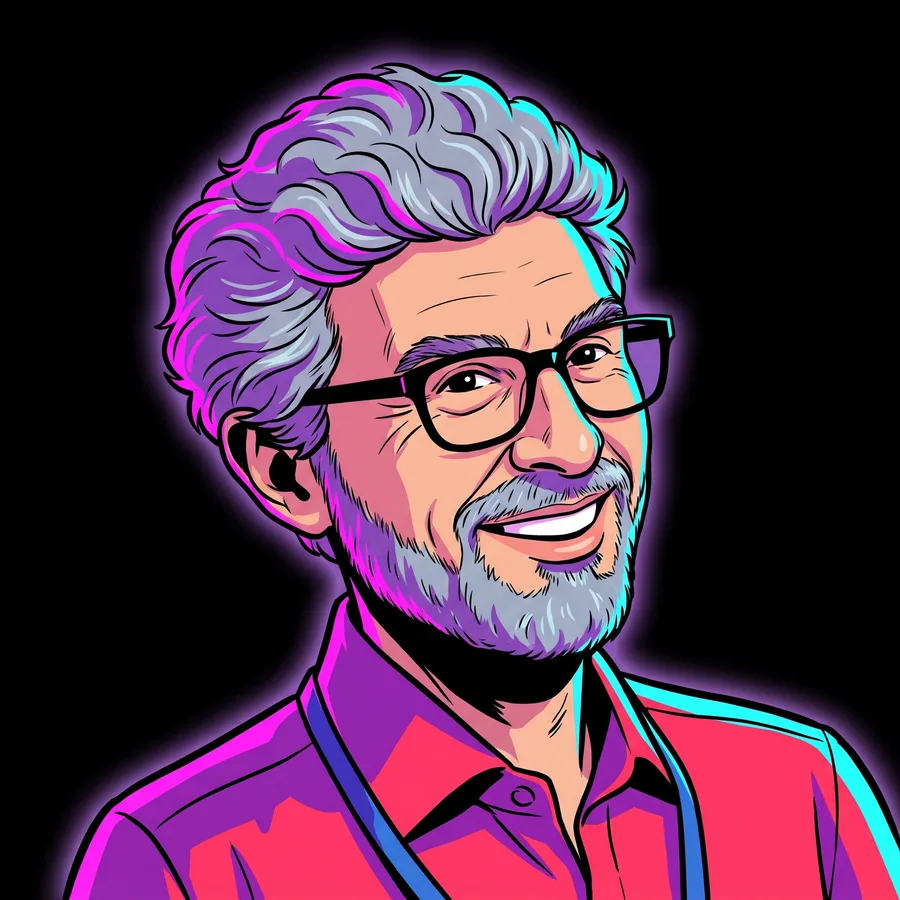
Yoshua Bengio was born in Paris in 1964 and grew up in Montreal, a city that would in time become his laboratory. From a young age he was fascinated by a question many in academia considered irrelevant: can a machine learn to represent the world the way a brain does? In the 1990s, when the "AI winter" had chilled enthusiasm for neural networks, he kept betting on them. It was a comfortable position for no one, but Bengio wasn't looking for comfort, he was looking for answers.
In 2003 he published with his collaborators the paper "A Neural Probabilistic Language Model," one of the most influential documents in the history of natural language processing. The central idea was elegant and radical at the same time: instead of memorizing grammatical rules, train a neural network to learn distributed representations of words (what we now call embeddings). Then in 2015, his team published the Bahdanau paper on "attention mechanisms" for machine translation, a key ingredient in the Transformers that power all of today's generative AI. Those seeds, planted quietly in academic papers, bloomed decades later in the language models that power assistants like Claude and GPT. In 2018, alongside Geoffrey Hinton and Yann LeCun, he received the Turing Award, computing's equivalent of the Nobel Prize, for his conceptual and engineering contributions to deep learning. Today he is also the most-cited living scientist in the world across all fields.
In addition to his professorship at the Université de Montréal, Bengio founded and leads Mila (Institut québécois d'intelligence artificielle), one of the world's largest academic AI research centers. Under his leadership, Montreal became a global hub for deep learning research, attracting talent from around the world. But perhaps what distinguishes him most today is what he did after the success: starting around 2022, when the field he helped build began to show its most serious risks, he raised his voice. He signed warning letters, testified before governments, and became one of the most respected voices in the debate over AI safety.
The lesson I take from Bengio is twofold. First: sometimes the right idea just needs someone patient enough not to let it go. Second: being right doesn't exempt you from responsibility for what comes after. Every time Claude understands what you write to it, there's an invisible thread leading back to that 2003 paper and to a researcher in Montreal who believed, before almost everyone else, that words could be learned too.
Official links for Yoshua Bengio, The architect of deep language
More figures who shaped AI in AI Legends, or back to the news.