
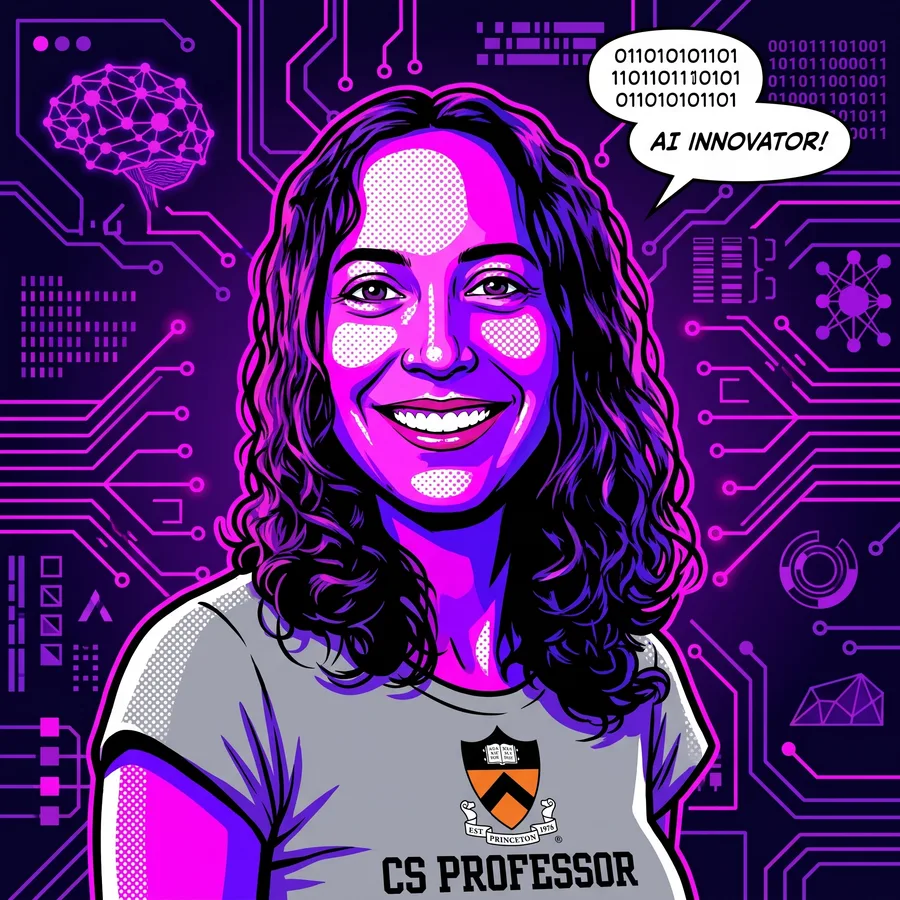
In the history of artificial intelligence, there are figures who invent the ideas and figures who put them to the test before the world. Olga Russakovsky belongs to the second group, and without her, the great leap of AI might have taken years longer. As a doctoral student at Stanford, under the guidance of Fei-Fei Li, she became one of the principal organizers of the ImageNet Large Scale Visual Recognition Challenge (ILSVRC), the annual competition that, starting in 2010, put the world's best algorithms to work identifying and classifying millions of images. It was painstaking, nearly invisible work, but it turned out to be the catalyst for an entire revolution.
In 2012, something happened that changed everything: AlexNet, the neural network presented by Geoffrey Hinton's team, won the ILSVRC by a margin that left the field speechless. While the second-place entry had an error rate of 26.2%, AlexNet reached 15.3%. That gap was not a refinement, it was a change of era. The competition that Russakovsky helped organize was the stage where deep learning proved, for the first time, that it could see as well as a human when classifying objects. The challenge drew on the ImageNet dataset, with more than 14 million labeled images across more than 22,000 categories, exactly the scale a neural network needs to actually learn.
After her doctorate at Stanford and a postdoctoral fellowship at Carnegie Mellon, Russakovsky joined Princeton as an associate professor of computer science, where she leads the Visual AI Lab and co-directs the Princeton AI Lab. In 2017 she co-founded AI4ALL, a nonprofit dedicated to opening doors in artificial intelligence to young people from underrepresented groups, an initiative she now chairs as president of its Board of Directors. The recognition followed: PAMI's Everingham Prize in 2016 for ILSVRC, MIT Technology Review's Innovator Under 35 in the same year, PAMI's Young Researcher Award in 2022, and in 2025 the Presidential Early Career Award for Scientists and Engineers (PECASE), the highest recognition the US government gives to researchers in the early stages of their careers.
What strikes me most about Russakovsky is that she helped build the benchmark that lit the revolution, and then had the clarity to ask what problems we had created in doing so. Her research into bias in computer vision is not the critique of someone who stood on the outside, but the reflection of someone who was inside and chose to look honestly. When an AI detects objects in a photo today, there is something of her work behind that capability, and also something of her work in the questions we should be asking about how that AI decides what it sees.
Official links for Olga Russakovsky, The architect of the machine's eye
More figures who shaped AI in AI Legends, or back to the news.