
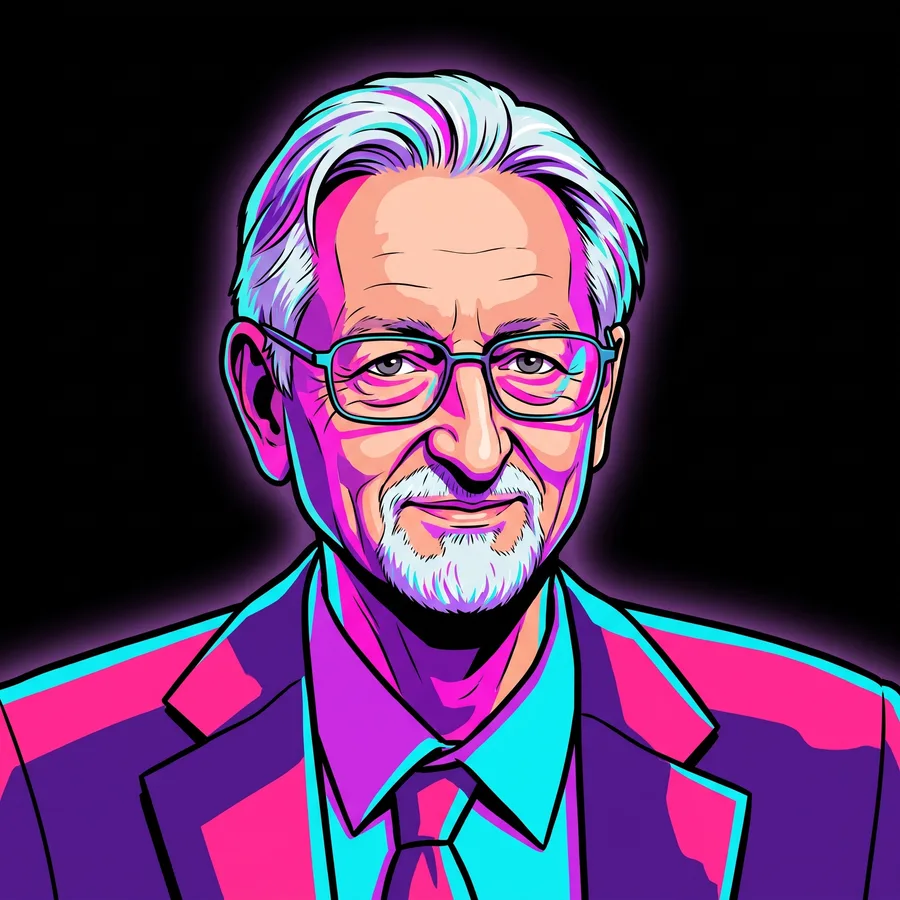
If modern artificial intelligence had a family tree, Geoffrey Hinton would sit near the root. This British-Canadian cognitive psychologist and computer scientist spent decades working on neural networks when most of the field had written them off. While others said the idea led nowhere, he kept going, stubborn and patient, convinced that a machine could learn a little the way a brain does.
In 1986 he helped popularize "backpropagation," the technique that lets a network adjust its own mistakes and improve on its own. But the moment that changed everything came in 2012: together with his students Alex Krizhevsky and Ilya Sutskever, he unveiled AlexNet, a network that crushed an image-recognition contest and left the world stunned. That was the spark that lit the deep learning revolution we live in today.
For that work he received the 2018 Turing Award (the "Nobel of computing") alongside Yoshua Bengio and Yann LeCun, and in 2024 a Nobel Prize in Physics. In 2023 he did something rare for someone at his level: he left his role at Google so he could speak freely about the risks of AI, without looking like he was defending a company.
To me, Hinton's lesson isn't only technical, it's human. He believed in an unpopular idea for years, endured the "that will never work," and when it did work, he had the honesty to warn about what he helped create. Every time you message Claude or generate an image, a little piece of that stubbornness of his is working underneath.
Official links for Geoffrey Hinton, The godfather of deep learning
More figures who shaped AI in AI Legends, or back to the news.