
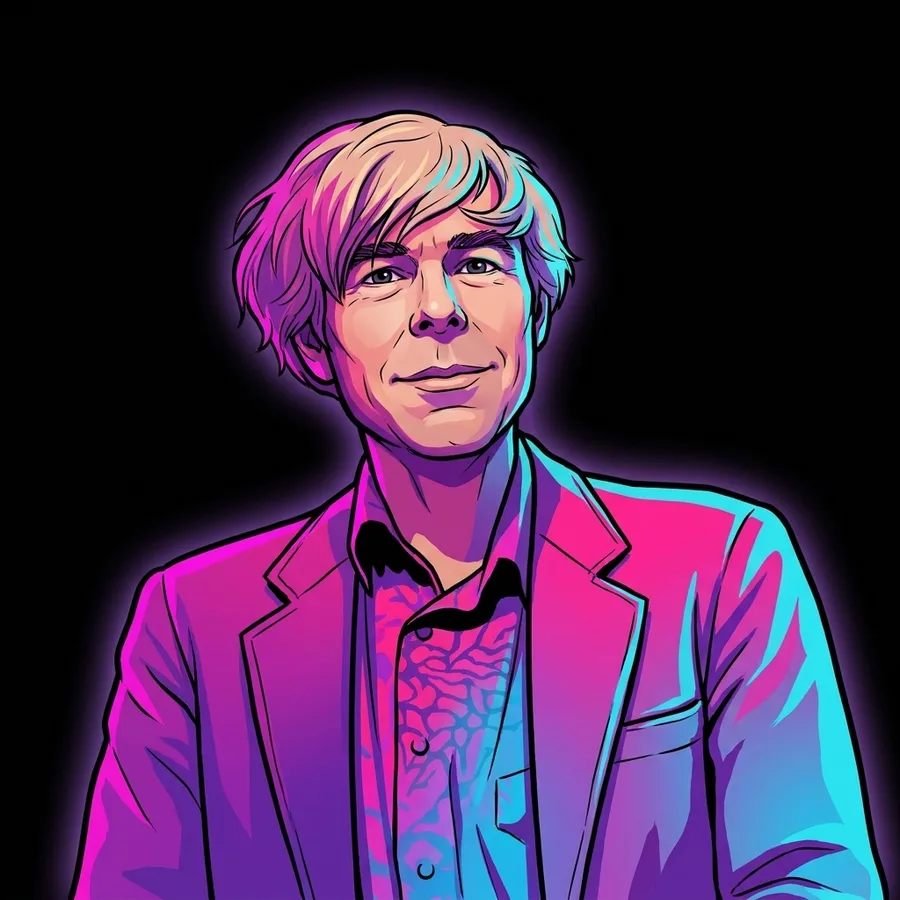
Some books you read and some books change how you think. "Gödel, Escher, Bach: An Eternal Golden Braid," published in 1979 by Douglas Hofstadter, does both. This physicist by training, son of Nobel laureate Robert Hofstadter, spent years wrestling with a deceptively simple question: how can a system be conscious of itself? To answer it, he wove together a mathematician who proved the limits of logic, an artist who drew impossible staircases, and a Baroque composer who built fugues that looped back on themselves. The central argument was as elegant as it was unsettling: consciousness emerges from "strange loops," self-referential patterns that create the illusion of an "I."
The book won the 1980 Pulitzer Prize for general nonfiction and the National Book Award in science, a rare double distinction for a work at once so technical and so philosophical. What made GEB required reading across mathematics, philosophy, and computer science departments was not just the argument but the form: Platonic dialogues, wordplay in multiple languages, ambigrams, canons, and recursion embedded in every chapter. It was a book that practiced what it preached. In 2007 Hofstadter deepened the idea in "I Am a Strange Loop," arguing that what we call a "self" is an emergent illusion, a high-level pattern that arises from millions of neurons following simple rules.
Since 1988 he has been Distinguished Professor of Cognitive Science and Comparative Literature at Indiana University Bloomington, where he directs the Center for Research on Concepts and Cognition (CRCC). With his group he developed Copycat (1988-1994, together with Melanie Mitchell), a pioneering program that modeled how humans make analogies, those unexpected connections between ideas that are, in his view, the very heart of creative thought. He also coined the term "ambigram" (1983-84), the visual figure that reads the same right-side up and upside down. He is a Fellow of the American Academy of Arts and Sciences and a member of the American Philosophical Society, both since 2009.
What fascinates me most about Hofstadter is that in a 2023 interview he admitted that the rapid advance of language models had shaken some of his certainties about what machines could never do. For someone who has spent decades thinking about the limits of AI to say "this surprised me" is not a sign of failure: it is a sign of intellectual honesty. GEB remains, nearly fifty years later, one of the best arguments for taking seriously the question of what makes something, human or machine, "conscious." If you have ever wondered why AI models respond in ways that feel almost human, Hofstadter has spent decades trying to explain exactly that.
Official links for Douglas Hofstadter, The man who asked if the mind can know itself
More figures who shaped AI in AI Legends, or back to the news.